| La’o Hamutuk |  |
 | Reference Presentations Mission Statement LH Blog Search Home |  |
| | La’o Hamutuk | |
| Reference Presentations Mission Statement LH Blog Search Home | |
11 October 2010. Updated 6 July 2026
|
Skip down for events during 2012, 2013, 2014, 2015, 2016, 2017, 2018, 2019, 2020, 2021, 2022, 2023, 2024, 2025, 2026 or documents. Background When Timor-Leste's Petroleum Act (also Portuguese) was enacted as Law No 2005/13 five years ago, one of the most important changes made during the year-long public consultation was the addition of Article 22 "State Participation in Petroleum Operations," which allows a state-owned National Oil Company (NOC) to participate in joint ventures for exploring and exploiting petroleum resources in Timor-Leste. Article 8 of the Model Production-Sharing Contract under the Petroleum Act allows an NOC to become a partner in petroleum exploration in Timor-Leste's exclusive areas, with up to a 20% share, without paying a share of the exploration costs already incurred. The NOC must declare its interest within 60 days of when a company declares a field as a "commercial discovery" after exploration finds profitable quantities of oil and/or gas. This applies only in Timor-Leste's exclusive land and sea territory; if the NOC wishes to participate in a joint venture in the Joint Petroleum Development Area or outside Timor-Leste's territory, it will have to purchase a share of the project just like any other oil company would. The NOC was not originally a partner in the Bayu-Undan, Kitan and Greater Sunrise fields in the JPDA, for which contracts were signed before the Petroleum Act became law and the NOC was established, but this changed after the Maritime Boundary Treaty became effective in 2019.
History In 2007, the previous Government drafted a National Oil Company decree law (also Portuguese) and held two rounds of public consultation on draft statutes for what was then called PETROTIL. La'o Hamutuk and others raised a number of serious concerns, and the election intervened before the law was passed. Our main points, which are still valid, are described in the box at right: The AMP came into office in mid-2007, promising to create a national oil company quickly. In May 2009, the State Secretariat for Natural Resources organized a two-day workshop for officials and civil society with speakers describing national oil company experiences in Mexico, Indonesia, Trinidad, Thailand, Norway and Papua New Guinea (links to presentations below). The first visible follow-up came almost a year later, and the Government had hoped to pass a Decree-Law establishing a National Oil Company by the end of 2010, so that it could participate if commercial quantities of petroleum were discovered at Cova or in Block K, where Eni and Reliance hope to drill test wells in mid-2010. (Wells were drilled at the end of the year, but no commercial discoveries were found.) A July 2010 draft of the law was circulated informally. In October, the State Secretariat of Natural Resources began a more formal public consultation in the districts. More than 60 people participated in an all-day public consultation on 18 November 2010 discussing newer drafts of the laws to create the PETRONATIL national oil company (also Tetum) and the Institute for Petroleum and Geology (also Tetum). After many questions and controversies were raised, SERN asked people to submit comments by 24 November, as they hope to present the two laws to the Council of Ministers on 30 November. La'o Hamutuk's submission on PETRONATIL highlighted the following points:
Our submission on IPG recommended that it be established during 2011 as a directorate within the State Secretariat for Natural Resources, rather than as an autonomous Instituto Publico. At their 16 December meeting, the Council of Ministers "analysed the proposal to create the Timor-Leste oil company that will detain and manage, with a managerial framework and principles, the property assets of the Timor-Leste State, in the oil sector." With exploratory drilling underway in both Eni's and Reliance's blocks, the government hopes to establish PETRONATIL in early 2011, with the help of $2 million allocated for in the proposed state budget for 2011, which was increased to $2.5 million in the final budget. In La'o Hamutuk's submissions to Parliament on the Budget we urged them to use the "power of the purse" to compel Government to create Petronatil with a Parliamentary Law. Following the consultation, the Government made some changes to the draft PETRONATIL Law, although we have not been allowed to see them. We understand that Government will be more involved in NOC strategic decisions. PETRONATIL will not borrow without Government approval, although Timor-Leste will be better protect from liability for PETRONATIL's debts. Petronatil officials will have to declare their assets. Since both Eni's and Reliance's exploratory wells came up dry, the time pressure to establish PETRONATIL has relaxed a bit, but SERN still wants it to have it operational by April 2011. That way it will be ready to participate in mid-stream and downstream operations on the South Coast (the supply base, refinery and possible fabrication yard and LNG plant in the Tasi Mane project), even if new exploration and production doesn't happen for some time. In early 2011, the draft IPG decree-law was put on the back burner, as SERN gave priority to other concerns. However, it was resurrected after a year and approved by the Council of Ministers on 14 March 2012. It went into effect when it was published in the Jornal da Republica (Portuguese) as Decree-Law No. 33/2012 of 18 July.
The President's legal staff invited La'o Hamutuk to discuss our concerns, and we followed up the meeting with a written submission on 14 June, concluding that "on balance, this decree-law will damage Timor-Leste’s economic development, political democracy and equitable use of its non-renewable resources. Therefore, we urge the President of the Republic to utilize his powers under Article 88.4 of the Constitution of RDTL to veto this legislation, and to ask the Government to repair its defects and submit it to Parliament for enactment ... after the 2012 election."
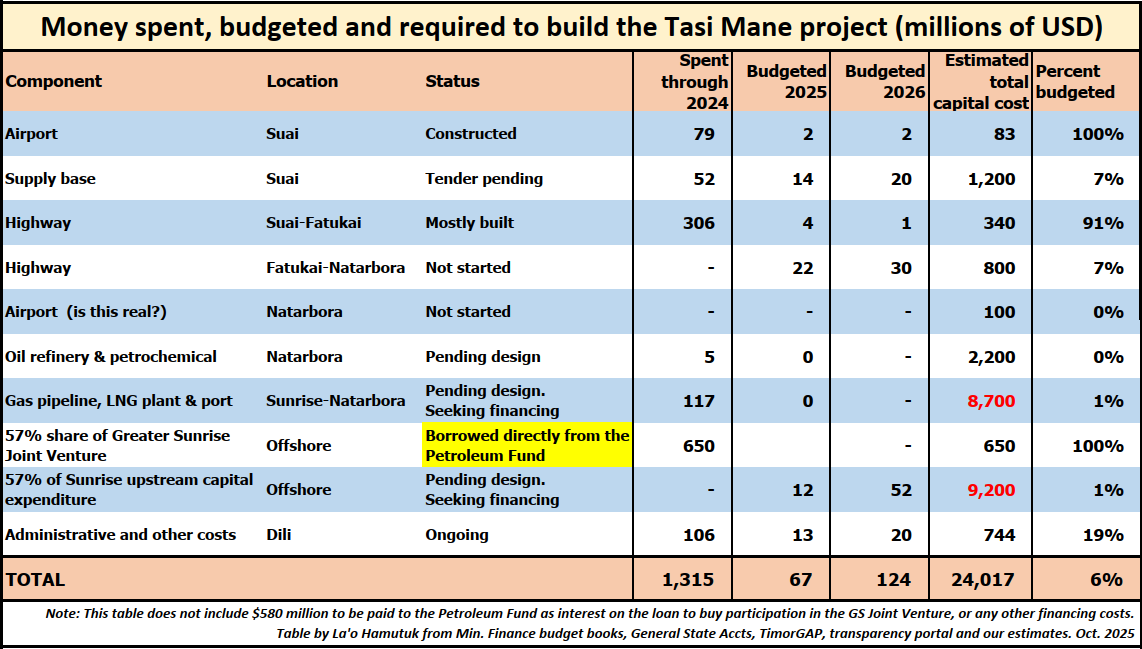
On 2 September, the Government appointed Eastlog PTE (also Portuguese) to build the Suai supply base, which is expected to cost around $300 million. Once it is built, TimorGAP will own and operate it. La'o Hamutuk's web pages on the Tasi Mane project, Suai Supply Base and state budgets have more details. On 28 September 2011, the Council of Ministers approved (also Tetum) Government resolution 29/2011 naming Francisco da Costa Monteiro as Chairman of the Board of Directors and Executive Director of TimorGAP - Timor Oil and Gas E.P. The following week, TimorGAP's new agreement with Malaysian Helicopter Services was useful, as SERN and TimorGAP officials flew to Suai to meet with concerned local residents and fly over proposed sites of the Supply Base and Nova Suai. On 17 October, SERN Despacho No. 106/GSERN/X/2011 named Antonio Jose Loyola de Sousa, Dino Gandara Rai and Norberta Soares da Costa to four-year terms as members of the board. A month later, Dili's new Timor Plaza luxury shopping mall celebrated TimorGAP's imminent arrival: "Given the prominence of TimorGAP as the national oil company, it was important to find a prestigious location for the new offices. 'Frankly speaking, there was no other choice but the Timor Plaza,' Monteiro said, 'Given the nature of TimorGAP’s operations, we have to be professional and presentable.' " On 17 February 2012, local newspapers included an advertisement for 22 positions with TimorGAP relating to several components of the Tasi Mane project, as well as an interview with TimorGAP President Francisco Monteiro (Tetum) explaining that "TimorGAP will be directly involved in oil exploration." Francisco stated that they would be involved in both upstream and downstream operations and services, as well as the Suai Supply Base, Betano refinery, and LNG pipeline and Beacu LNG plant. TimorGAP continues to focus on Tasi Mane, with the first priority being given to the Suai Supply Base and the highway. The refinery is being discussed with PTT Thailand, while the LNG plant continues to depend on negotiations with Woodside about how Sunrise gas will be processed. On 1 June 2012, Prime Minister Xanana Gusmão named TimorGAP President Francisco Monteiro to the Investment Advisory Board for the Petroleum Fund. According to IAB meeting minutes, he has attended only two of the eight meetings held since his appointment, missing every meeting during 2013 and the last four months of 2012. During 2012 and 2013, TimorGAP's principal activities related to design, contracting and land clearance for the Tasi Mane project, especially the Suai Supply Base. Our web pages on these topics contain much more information.
The 2013 State Budget appropriates $101 million for EDTL generator fuel and projects expenditures of $122 million in 2014 and more in the future. On 13 April 2013, TimorGAP signed its first Production Sharing Contract (PSC) as a 24% partner in a joint venture for area 11-106 in the Joint Petroleum Development Area. The project will be operated by the Italian company Eni, which owns 40.53% of it, and the Japanese company Inpex owns 35.47%. The contract, signed without an open bidding process, covers 662 square km of relinquished portions of JPDA 06-105, near the Kitan field. The companies committed to drill two exploration wells within two years, and plan to tie into Kitan if a commercial discovery is made while Kitan is still production. The signing was announced by ANP and celebrated by TimorGAP (also Tetum) and Timor-Leste's government (also Tetum). ANP published PSC JPDA 11-106 to their website seven months later. In November 2013, TimorGAP explained to Parliament why the Tasi Mane projects are moving so slowly, with only 4.2% of their $139 million 2013 appropriation expected to be executed by the end of the year. According to law, TimorGAP is required to present an annual report to Parliament by the end of June of the following year, but by 30 June 2014 they had never published a single report. Based on this and other concerns, on 5 August La'o Hamutuk wrote an open letter asking the Court of Appeals to investigate TimorGAP's finances and management. Among the issues we suggested the Court could explore are:
On 7 November 2014, TimorGAP and other institutions under the Ministry of Petroleum and Mineral Resources testified before Parliament Committees C and D (Tetum) on the proposed State Budget for 2015. La'o Hamutuk's letter to Parliament on the budget discussed TimorGAP and the Tasi Mane project. Although the President of TimorGAP left before MPs could ask him questions, his staff distributed the 2011-12 and 2013 Annual Reports of TimorGAP, which were presented to the Council of Ministers two weeks later and published on TimorGAP's website in mid-December.
Although the 2012 report implies that the Audit Board required by Articles 7(b) and 15-18 of TimorGAP's Bylaws will be established, it is not mentioned in the 2013 report. Neither report contains financial information on the profits and losses of their various business ventures. Unfortunately the Court of Appeals Audit Chamber's 2015 Action Plan does not include an audit of TimorGAP, as La'o Hamutuk had suggested. (However the court later published verification reports of TimorGAP's accounts for 2011-12 and 2013. On 17 March 2015, La'o Hamutuk wrote a letter of protest to the National Procurement Commission regarding their intent to award a contract for preliminary design of the LNG Plant in Beacu. We explained that uncertainties around the Greater Sunrise pipeline and TimorGAP's managerial record, as well as the many years which will pass before this project is built, make it inadvisable to spend even more of Timor-Leste's people's money on the Beaçu LNG dream.
In August, TimorGAP officials signed the largest contract in Timor-Leste's history, $719 million for the Suai Supply Base. The prize went to the Korean company Hyundai Engineering and Construction, which has been fined and blacklisted in Korea for collusion. In late October, the Audit Chamber rejected this contract, and the Government appealed this decision to the Court of Appeals. In mid-February 2016, local media reported that Hyundai had virtually closed its Dili office. (The Court of Appeals reversed the Audit Chamber's decision in July 2017, but the project's future remains uncertain.) In October, the Council of Ministers reappointed Francisco da Costa Monteiro for a second four-year term as TimorGAP's President. The proposed 2016 State Budget will subsidize TimorGAP with a $6 million Public Transfer from the Ministry of Petroleum and Mineral Resources, 10% lower than in 2015. On 18 November 2015 Timor-Leste's petroleum related institutions, including TimorGAP, presented materials, including their Strategic and Business Plan 2015-2035, to a Parliamentary hearing on the budget.
At the end of January, ANPM officially announced the offshore PSC awarded to TimorGAP. The Chinese company BGP started offshore seismic research as soon as this Resolution was published on 22 December, working through Christmas to hand over the results to TimorGAP and ANP on 10 March 2016. TimorGAP will pay BGP $11.4 million over the next three years for this 'Crocodile' 3D seismic survey data, which covers 2,780km2 in the TLEA. The following week, TimorGAP invited bids (circulating a draft Service Agreement) for an contractor to process the seismic 3D data "sufficient for detailed structural and stratigraphic interpretation and precise reservoir characterization." A few weeks later, TimorGAP published clarifications and addenda to the tender. After extensive analysis by TimorGAP and consultants, exploration wells could be drilled in 2017. In March, TimorGAP invited La'o Hamutuk to a 'public consultation' on the environmental impacts of the proposed Betano refinery, and we wrote them an open letter in May raising some serious concerns. TimorGAP released its annual report for 2015 (also Portuguese) in June 2016. In July 2016, the Court of Appeal Audit Chamber published a Verificação Interna de Contas (VIC) da TimorGAP for 2011-12. The proposed state budget for 2017 would nearly double the state subsidy for TimorGAP, from $6 million to $11.9 million. As Parliament debated the budget in October, TimorGAP made presentations to a Petroleum Fund Seminar and to Parliament Committee C. La'o Hamutuk's submission on the budget questioned the need for TimorGAP, saying "TimorGAP’s main activities seem to be propaganda to mislead people that there is a lot of undiscovered oil and gas in Timor-Leste, paying millions to Chinese companies for seismic exploration in unpromising waters, building petrol stations which compete with private companies that do not need state subsidies, serving on joint committees with Australia about managing the stalled Sunrise project, starting short-lived joint ventures (such as Gap-MHS) to transfer part of the operational costs of Kitan from the nation’s petroleum revenues to their own treasury, and dreaming of trips to Cuba for speculative oil exploration. ... Is it worth $12 million?" During the Parliamentary budget hearings, Deputies asked many questions to TimorGAP and related agencies, which were answered in writing. In the end, the enacted 2017 state budget contained the $11.9 million grant for TimorGAP. In February 2017, the Court of Appeal Audit Chamber published a Verificação Interna de Contas (VIC) da TimorGAP for 2013.
TimorGAP released its 2016 Annual Report (also Portuguese) and Financial Statements in June 2017. On 5 July, TimorGAP announced that it had identified "world-class prospectivity" in its offshore block SO-15-01. On 18 July 2017, the Court of Appeals reversed (43 MB scanned original) the Audit Chamber's decision to reject the Suai Supply Base contract, but the project's future remains uncertain. Timor-Leste elected a new Parliament the following week.
TimorGAP released its 2017 Annual Report (also Portuguese) in July 2018. The report shows that TimorGAP received an $11.9 million grant from the Timor-Leste government in 2017, resulting in a $6 million profit. During the last four months of 2018, TimorGAP played a key role in negotiations to purchase 30% participation in the Greater Sunrise Joint Venture from ConocoPhillips for $350 million and another 23.56% from Shell for $300 million. If these purchases go through, TimorGAP will manage Timor-Leste's majority ownership of the project. La'o Hamutuk has created a separate web page with more information about these complex and important transactions. The 2018 State Budget, enacted in September 2018, includes a grant of $7 million for TimorGAP. On 8 December TimorGAP presented their optimistic projections for the economic benefits from the Greater Sunrise pipeline and the Tasi Mane Project at a public seminar. They also released studies by ACIL Allen of the economic benefits from Tasi Mane and Greater Sunrise, which were contracted by TimorGAP and based on TimorGAP's assumptions, as well as TimorGAP's Strategic & Business Plan 2016-2035. The same material was presented to Parliament during the budget debate a few weeks later, and the enacted 2019 State Budget includes a grant of $16.9 million to TimorGAP.
TimorGAP released its 2018 Annual Report (also Portuguese) in June 2019. The report shows that TimorGAP received an $9.95 million grant from the Timor-Leste government in 2018, resulting in a profit of less than one million (including subsidiaries). Although their income was $1.5 million lower in 2018 than in 2017, largely due to the smaller government grant, their expenses increased by $1.6 million. An audited financial statement was published in the Jornal da Republica. In October 2019. Parliament considered the Government's proposed 2020 budget, and TimorGAP presented a report on its current activities and a proposal for 2020 (the government's proposed budget was withdrawn in early December, pending revision). TimorGAP asked for a $74.9 million subsidy from the budget (more than four times what they got in 2019) to add to their $3.4 million in other revenues. Most of it will be spent on Sunrise and Tasi Mane:
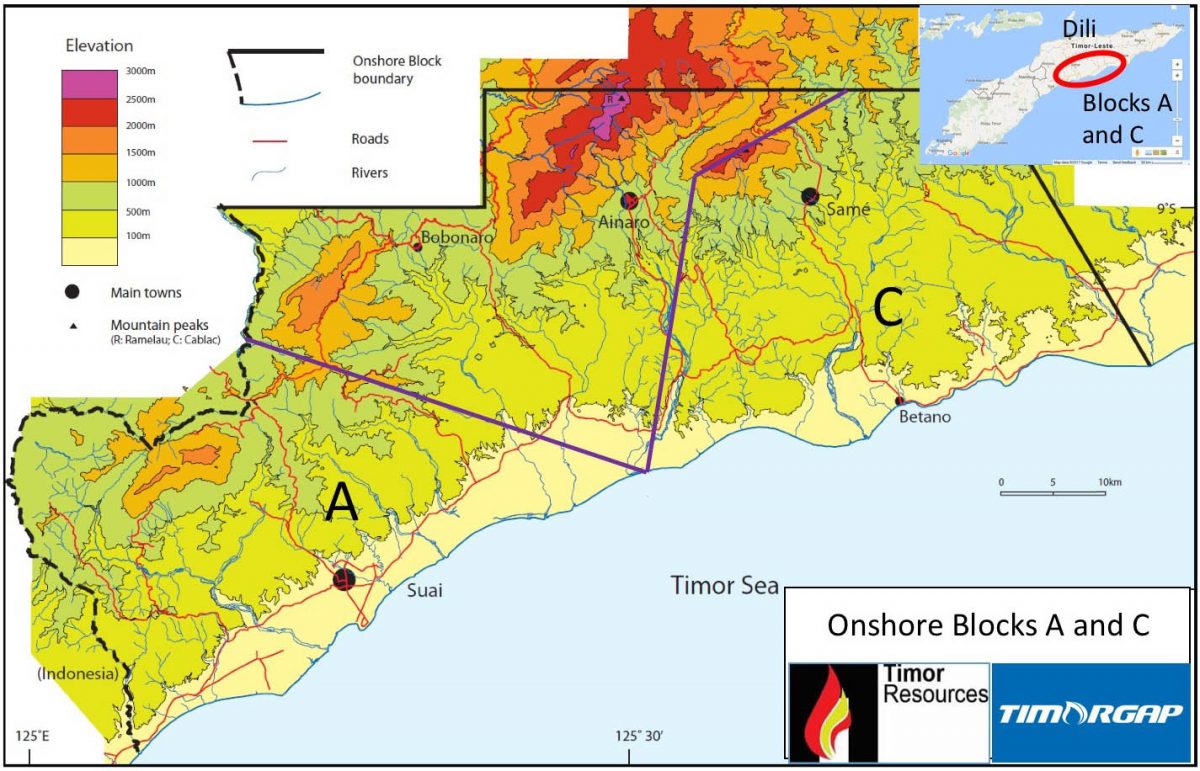
On 6 November, the Council of Ministers renewed the four-year terms of TimorGAP CEO Francisco da Costa Monteiro, and board members António José Loyola de Sousa, Dino Gandara Rai and Norberta Soares da Costa, as reported in the Jornal da Republika. Government proposed a revised 2020 state budget to Parliament in December, with the same $74.9 million appropriation for TimorGAP. However, Parliament rejected the entire 2020 budget in mid January, and the state operated under a duodecimal system which limits expenditures each month to 1/12 of the 2019 level. The 2020 budget was not enacted until October, and before then TimorGAP received less than $1.4 million each month, less than one-fourth of what they expected. On 30 January, TimorGAP gave a presentation on the Tasi Mane Project (Tetum) to a colloquium organized by the Petroleum Fund Consultative Council and Rede Feto. The spoken words were more cautious than the unlimited optimism in the slides. On 8 July, incoming Minister of Petroleum and Minerals Vitor Soares proposed to the Council of Ministers to replace TimorGAP CEO Francisco da Costa Monteiro with his deputy, António José Loiola de Sousa. The Council agreed, as reported by Upstream and Tatoli (Tetum). Over the next few months, polemics and accusations between the former and new leadership were reported in the Timorese media, as summarized in Asia Times. The new leadership said that prior studies about Tasi Mane feasibility were not valid and that new studies would be needed before going ahead, while former CEO Francisco Monteiro defended those studies (TimorGAP issued a press release in rebuttal) and accused Fretilin. Mari Alkatiri and Xanana Gusmão joined the public debate. The 2020 State Budget was enacted in October 2020, and allocates $15.23 million for TimorGAP. In November, the government enacted Decree-Law 61/2020 to regulate the supply of fuel to the national electricity system by TimorGAP. A tender is pending. The 2021 State Budget was enacted in December 2020 and allocates $70.69 million for TimorGAP. None of the 2020 or 2021 budget documents contain any specific information about how this money will be used. When the budget was revised in early 2021, this allocation was reduced by $5 million. $35.3 million was transferred to TimorGAP in February 2021, and the remaining $30.4 million was transferred in August. The onshore joint venture of TimorGAP and Timor Resources continues to research potential onshore oil and gas in Covalima and Manufahi districts, and drilled the first exploration well in October 2021. More information is available here. The proposed 2022 State budget would have transferred $34.7 million to TimorGAP. The budget books reveal that TimorGAP devalued its holding in Greater Sunrise from $700 million to zero at the end of 2020. This information should be in TimorGAP's 2020 Annual Report and financial statements, which by law should have been published by June 2021, but were still not available in February 2022, as noted by the Audit Court. Nevertheless, Parliament agreed to the request from the Minister of Petroleum and Minerals and increased his budget by $40 million; and TimorGAP will get $62.2 million in 2022. On 7 December 2021, ANPM signed a no-bid Production-Sharing Contract for exploration in a large onshore area around Pualaca which straddles three municipalities. More information here. In late March 2022, nearly nine months after the statutory deadline, TimorGAP published its 2020 Annual Report. On 24 June, authorities held a launching event for the Pualaca exploration. La'o Hamutuk attended and wrote TimorGAP begins exploring Pualaca Block by itself. Although TimorGAP requested a $141 million state subsidy for 2023, the amount was cut back to $54 million in the Government's budget proposal to Parliament. TimorGAP made a short presentation to Parliament Committee D on 10 October.
During the first half of 2023, TimorGAP promoted itself in Timor-Leste and around the world. TimorGAP and Timor Resources engaged in a public dispute about paying for onshore oil exploration, as discussed elsewhere on this website. The Council of Ministers enacted Decree-Law 24/2023 of 24 May (Port.) (also English), the first revision to TimorGAP's authorizing statute and bylaws. The incoming CNRT Government revised them again with Decree-Law 61/2023 of 6 September (Port.) TimorGAP published its Annual Report for 2022 in early September, although it was legally due at the end of June. On 13 September, the Council of Ministers approved the nomination by Minister of Petroleum and Mineral Resources (and former TimorGAP President) Francisco da Costa Monteiro of Rui Maria Alves Soares to be President of TimorGAP for the next four years. The outgoing TimorGAP leadership published a
list
of their accomplishments (also
Tetum)
during 2020-2023. In September, TimorGAP took a 16% share in the Bayu-Undan Joint Venture, even though the field was already depleted. In November, TimorGAP published its 2023 Annual Report, more than four months after the legal deadline. In December, the Audit Chamber of the Court of Appeals issued a critical report (Port.) on TimorGAP's activities during 2017-2019. The audit was undertaken partly in response to a letter that La'o Hamutuk wrote more than ten years ago. In February, the ANP announced that TimorGAP is taking a 12.5% interest in Eni's SO-22-23 project, exercising the state’s legal right of participation. At the end of April, Sunda Gas announced that TimorGAP's share of the Chuditch project will increase from 40% to 70%. Timor-Leste's public company will pay 72% of the drilling costs for the pending exploratory well, which could exceed $100 million. A Timorese analyst wrote Chuditch Gas Field: High Stakes and Diverging Strategies in the Timor Sea to warn of TimorGAP's "high-risk, politically driven play". The agreement lapsed in June when Sunda failed to carry out their drilling schedule, but it could be reinstated. Also in April, TimorGAP requested international consultants to bid for a $26 million contract for project management of the design/build/finance contract for the Suai Supply Base.
Production from Bayu-Undan ended in June. In July, TimorGAP transferred half of its interest in the Pualaca project to the Chinese company Guangdong Fushan Tengfei International Tourism Co., Ltd., although TimorGAP will still operate the project. In August, TimorGAP published its 2024 Annual Report. In September, TimorGAP received a 10% interest in the TL-OT-22-22 onshore project from HTS. TimorGAP and Finder agreed to increase TimorGAP's share of the Kuda Tasi/Jahal project from 24% to 34%, and that TimorGAP would spend millions more to develop it, as announced by ANP in October. TimorGAP expects production by early 2028. In October, TimorGAP presented to Parliament in support of the proposed State Budget for 2026, which escalates spending on Sunrise and the Tasi Mane Project. ANP signed the onshore contract TL-OT-25-24 with TimorGAP and the Timorese company PetroTim Resources on 26 November 2025. In January 2026, ANP and Timor GAP agreed to conduct a joint study with Petronas Carigali of Malaysia on possible uncontracted offshore petroleum basins south of Timor-Leste. In July, TimorGAP published its 2025 Annual Report. For current information on TimorGAP's petroleum exploration projects, including Pualaca and Rarahana, see our page on Petroleum Projects.
Legislation
Older versions
|
||
|
Background documents
Presentations from May 2009 Workshop on Setting up an NOC in Timor-Leste |
| The Timor-Leste Institute for Development Monitoring and Analysis (La’o Hamutuk) Institutu Timor-Leste ba Analiza no Monitor ba Dezenvolvimentu Rua Felicidade (Rua Cardoso Dias), Gricenfor, Bairro Central, Dili, Timor-Leste P.O. Box 340, Dili, Timor-Leste Tel: +670-3321040 or +670-77234330 email:laohamutuk@gmail.com Web:https://www.laohamutuk.org Blog:laohamutuk.blogspot.com Facebook |

 On
20 July, the President declined to follow our recommendation and
signed the decree-law without any public announcement. It was
published as
On
20 July, the President declined to follow our recommendation and
signed the decree-law without any public announcement. It was
published as