 | La’o Hamutuk |  |
The Greater Sunrise Oil and Gas Project
29 April 2010, updated 17 April 2015
Contents of this
page
The Greater Sunrise oil and gas field in the Timor Sea has been the subject
of exploration, controversy, and negotiations since it was first discovered in
1974. In particular, the question of where to liquefy the natural gas --
converting it into LNG which can be shipped to overseas customers -- has been
vociferously debated since Indonesia was forced out of Timor-Leste in 1999.
| |
Most of the graphics below
can be enlarged by clicking on them. Any which are reprinted should be
credited to La'o Hamutuk. |
| |

The Sunrise and Troubadour fields (yellow circle) are partly in the
Joint Petroleum Development Area defined by the Timor Sea Treaty, and
partly in disputed waters temporarily administered by Australia. |
| |
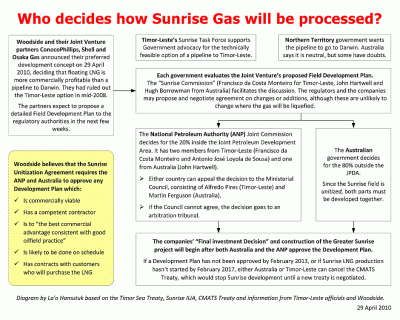
The decision on where the gas will be
processed is proposed by the companies and must be approved by
regulatory authorities in both Australia and Timor-Leste. |
| |

This graph shows La'o Hamutuk's 2010 projections of the revenues Timor-Leste
will receive each year from taxes and royalties from the Bayu-Undan,
Kitan and Sunrise fields. The "upstream" revenues for extracting Sunrise
gas and oil ($16 billion) will come to this country wherever the LNG
plant is built, but Timor-Leste will only receive the additional
"downstream" revenues ($3.4 billion) for processing the gas if the LNG
plant is built in Timor-Leste. |
| |

This map is adapted from the International Unitization Agreement (IUA),
showing that 20% of the Greater Sunrise fields (left of the black
diagonal line) is inside the Joint Petroleum Development Area
administered by the Timor-Leste National Petroleum Authority (ANP),
while the other 80% lies in waters attributed to Australia under the
CMATS treaty. Although it is covered by four Production Sharing
Contracts (purple numbers), the orange and green areas will be developed
as a single unitary project. If a floating LNG plant is built, it will
probably be in the shallower parts of this area, toward the south. |
| |

If a pipeline is built to Timor-Leste, it
will have to be routed across the deep Timor Trough and will probably
land near Beacu. |
| |

Shell artist's conception of a floating LNG plant. |
| |

Students and others demonstrate in support
of a pipeline to Timor-Leste, Dili, 29 September 2010 |
| |

From Woodside
presentation, February 2011. Timor-Leste doubts these reserve
estimates, which are smaller than prior ones. |
|

The onshore LNG plant (click for
larger map) is part of the Government's vision for a
Tasi Mane petroleum industry
corridor in southwestern Timor-Leste.
 |
|

The maritime boundaries between Timor-Leste and Australia have never
been agreed to, resulting in continuing controversy. |
After moving ahead in fits and starts, the Sunrise project is now getting
closer to reality. This web page will include information and analysis about the
project, especially events in 2010. For background and basic information, see
the references linked to from the history section below.
Since 2010, the discussion over Greater Sunrise has
intensified, with Timor-Leste’s government, other Timorese politicians and NGOs,
Woodside, the Australian government and many commentators offering their views.
Timor-Leste media have been filled with polemics and misinformation regarding
the Greater Sunrise gas field and the LNG plant that will go with it. La'o
Hamutuk is a Timorese civil society organization which hopes that this project
will give the maximum benefit to the Timorese people. We are concerned that many
of the reports misrepresent the reality of the situation, which has economic,
legal, technical and environmental aspects, not only politics, and we hope that
this web page will help people better understand the issue.
History and background
In February 2008, La'o Hamutuk published a book
Sunrise LNG in Timor-Leste: Dreams, Realities and Challenges, which is
on-line in English and
Bahasa Indonesia, with a
summary in Tetum. The report includes a
history of relevant events from 1970 through 2008.
The Sunrise controversy is entangled in the troubled history of maritime
boundary negotiations between Timor-Leste, Australia and Indonesia which dates
from before the Indonesian invasion. Follow
this link for texts and commentary on the 2006 CMATS agreement or read a
La'o Hamutuk Bulletin
overview report
from that time or a later
2007 article.
CMATS has some time limits, including that if a Sunrise development plan has not
been approved by both Timor-Leste and Australia by February 2013, either country
can unilaterally cancel most provisions of the treaty.
In 2004, La'o Hamutuk wrote a briefing paper for Timor-Leste's boundary
negotiators entitled The Case for Saving Sunrise,
suggesting that there was no advantage to Timor-Leste in developing the Sunrise
field quickly, and that a delay of 10-15 years would greatly increase the
benefits Timor-Leste's people would receive. Six years have passed, and our
subsequent research confirms this view, which is now supported by many of
Timor-Leste's leaders.
During 2008 we published a
primer on LNG Basics
and an article on
potential benefits from Sunrise LNG in Timor-Leste.
The companies
The Sunrise project is operated by Woodside (Australia), which has a
33% share in the project shared with joint venture partners ConocoPhillips (USA,
30%), Royal Dutch Shell (UK/Netherlands, 27%) and Osaka Gas (Japan, 10%). They
maintain that the development plan is strictly a commercial decision, to be made
in the best financial interests of their stockholders and the Australia and
Timor-Leste governments, under the rules as defined by the
2002 Timor Sea Treaty, the 2003
Production-Sharing Contracts, the 2003
International Unitization Agreement and the
2006 CMATS Treaty.
In June 2008, Woodside presented a "Concept Screening" report to the
Australian and Timorese regulators, finding that a pipeline to Timor-Leste would
be less profitable than a floating LNG project or a pipeline to Darwin. After
world oil market prices collapsed later that year, they redid the study and
reached the same conclusions the following year. Woodside promised to announce
their decision between a mid-sea floating LNG plant (the first in the world) and
expanding the existing LNG plant in Darwin by the end of 2009, but did not meet
their deadline.
Woodside's Annual Report from 2009 explained their view of the Sunrise
project as of the end of that year.
Shell, which would like to develop floating LNG technology for use at other
fields, has long supported this option. ConocoPhillips, on the other hand, built
and operates an LNG plant at Wickham Point in Darwin, where the gas piped from
Bayu-Undan is processed. They would like to expand that facility to liquefy
Sunrise gas as well.
The governments
In mid-2008, Timor-Leste's
State Secretariat for Natural Resources (SERN) created a Sunrise Task Force to
develop their own information on the technical, economic and social aspects of
the Sunrise project. The Task Force, with help from Petronas and a bathymetric
(seabed depths) study supported by Korea Gas, concluded that a pipeline to
Timor-Leste is technically possible -- a view which is also held by Woodside and
Australia in recent years. Although the Task Force report has not been made
public, it questions Woodside's determination that a pipeline to Timor-Leste is
less profitable than the other options. However, as neither side has yet shared
the details of their assumptions and analysis with the other, it is difficult to
perform an independent assessment. Only one option will be chosen at the end of
the day, regardless of whether others are also feasible.
La'o Hamutuk arranged a briefing by the Sunrise Task Force for ourselves and
other civil society groups in February 2010, but we were not given technical
details and are not at liberty to publish specifics. However, it is clear that
the united Timor-Leste view is that the pipeline must be brought to Timor-Leste
-- that this is the only fair outcome, since the pipeline for the other large
gas field in the Timor Sea (Bayu-Undan), has already been built to Australia.
Timor-Leste's Government hopes to use an onshore LNG plant in Beacu (Viqueque
district) as the engine and centerpiece of a "national petroleum corridor"
stretching westward along the south coast to Suai. By developing local industry,
expertise and spinoffs, they hope to wean this country away from dependency on
oil rents (royalties and taxes) and toward productive activities which can
continue to thrive after the Sunrise and Bayu-Undan fields are empty. La'o
Hamutuk hopes that this is possible, although we believe that not enough has
been done yet in education, law-making, planning and infrastructure sectors for
Timor-Leste to maximize its benefits from Sunrise LNG.
Australia has largely remained silent on the pipeline route, saying
it's a matter for the companies to decide, However, this is disingenuous as
Australia actively negotiated the three relevant treaties with Timor-Leste, and
had largely achieved its goals by 2007. On 28 April 2010, the
Australian Ambassador responded to accusations
that his government had threatened Timor-Leste.
The public debate in 2010
In early 2010, the Government of Timor-Leste decided to take a hard public
line: they would not approve any development plan which didn't include a
pipeline to Timor-Leste and an LNG plant on the south coast. A 13 January press
release Woodside’s development plans will not be
approved for Greater Sunrise (also Portuguese)
provoked extensive coverage in the local and international media. Over the next
week, comments emerged from
Woodside,
Australia and
Petronas, and it was
clear that Timor-Leste had brought renewed attention to the debate. However,
Timor-Leste has consistently said that it will keep its legal commitments in
treaties and contracts Timor-Leste has already signed.
A month later, the RDTL Government publicly
attacked former Prime Minister Mari Alkatiri (also
Tetum) for offering suggestions on the Sunrise
question. When President Jose Ramos-Horta suggested that a floating plant might
be a compromise decision, the Government also disagreed. On 10 April, the
Government spokesperson reaffirmed his
January statement that any plan not involving an LNG plant in Timor-Leste would
be rejected.
After repeated delays, on 29 April 2010 the
Sunrise Joint Venture announced its preference for a floating plant.
Timor-Leste's government responded (also
Tetum) late that night, denouncing Woodside's
"unacceptable level of arrogance" and reiterating that Timor-Leste "will not
accept or endorse this concept and it’s associated plan now or in the future."
Woodside's announcement was echoed by
Shell and reported in the
media, as was
Timor-Leste's rejection.
Woodside said it plans to propose a Field Development Plan to Timor-Leste and
Australian authorities in the next few weeks, and hopes to move the discussion
past polemics to details. CEO Don Voelte was proud of their decision in his
speech to Woodside's Annual General
Meeting (see page 5) the following day.
Timor-Leste, on the other hand, "considers Woodside’s announcement a waste of
valuable time, money and human capital; presenting a concept preference before
appropriate consultation with the 'resource-owners'."
On 18 May, Woodside executives attempted to deliver their proposed Field
Development Plan to the National Petroleum Authority (ANP) in Dili, but ANP
refused to accept it. ANP president Gualdino da Silva said "the ANP was not in a
position to accept the folders and they must take them back because they have
not done all their homework," according to
Australian media reports. For more than a year, the ANP has been telling
Woodside to do a comparative analysis of three options (Darwin, Timor-Leste and
floating) and obtain regulatory approval for a design concept before the
company prepares a detailed plan like the one it tried to present.
During the ensuing few weeks, the Sunrise debate was a subject of much
coverage in the local and international media, with varying degrees of accuracy
and objectivity. La'o Hamutuk continues to discuss the issue with many parties
-- ANP, SERN, as well as the representatives of Woodside and Australia in
Timor-Leste, among others -- to try to understand what is happening.
Two recent press releases from the Timor-Leste Government maintained their
position that the pipeline must come here, although some of the arguments seem a
bit strained: Timor-Leste requires equitable
benefits through Greater Sunrise (31 May, also
Portuguese) and A lesson for Woodside in
compliance; Timor-Leste can wait (4 June). The "Equitable benefits"
press release cites a 2002 ACIL
report, a 2002 Australian Parliamentary
Report and a 2009 Poten report which
we have made available on this website.
From the other side, Woodside published a "Floating
LNG at Sunrise" presentation their CEO gave at a UBS Resources Conference in
Sydney on 3 June 2010. The company wrote to ANP in mid-June saying that it would
present separate evaluations of three development options.
As both sides kept talking past each other, with continuing media coverage
about the impasse, the Timor-Leste Government issued a
press release (also
Portuguese) on 22 June confirming that negotiations with Australia (albeit
not with Woodside) continue through normal channels. Articles in international
media tried to summarize the controversy, such as this one from
Pacific Scoop.
The Sunrise Commission and Joint Commission met in Dili on 28 and 29
September. The previous day, an all-day seminar at the National University
of Timor-Leste rallied students and others to support Timor-Leste's demand for
the pipeline to come here, and two days of demonstrations and marches greeted
the negotiators. During the talks, which were occasionally heated,
Woodside presented Australia and Timor-Leste with three loose-leaf binders,
presenting their analysis of pipelines to and LNG plants in Darwin, Beacu, and
floating in mid-water. Spokespeople for Timor-Leste claimed that this indicates
a change of Woodside policy and a willingness to evaluate the three
alternatives, although Woodside maintains that it still prefers the floating
option. Woodside's third-quarter report to Australian stock exchange regulators
said simply "In September the Sunrise Joint Venture submitted its Concept
Evaluation Reports to the Joint Petroleum Development Area and Australian
regulators at the Sunrise Commission in Dili."
Although Woodside has said nothing on the subject since then, Timor-Leste's
government has issued several press releases:
Timor-Leste has active regulators in the petroleum sector (2 November 2010),
Timor-Leste extends a lifeline to Woodside
(9 Nov) and Government of Timor-Leste
concerned about Woodside’s corporate downgrading by the Standard and Poor’s
Ratings Service (8 Dec). As of early December, Timor-Leste has not responded
to the Concept Evaluation Reports that Woodside submitted nine weeks earlier.
Separately, Timor-Leste's Ministry of Finance is investigating whether
Woodside and other companies owe back
taxes to Timor-Leste for selling Production Sharing Contracts, including
Woodside's sale of their 40% share in JPDA06-105 to Eni in 2007.
The Sunrise negotiators met in December, but talks broke down, reportedly
because Australian representatives were frustrated with Timor-Leste's insistence
that the LNG plant be built here.
Stalemate
continues in 2011
On 24 January 2011, Timor-Leste's government issued an unusually
confrontational press release: Greater Sunrise negotiation
forces Woodside to halt all operations. Later that week, President
Jose Ramos-Horta,
FRETILIN and
Mari Alkatiri urged continuing dialogue,
while Woodside reiterated its position
that it follows the law and prefers a floating LNG plant, as described in
The Australian. The next Sunrise
Commission meeting was scheduled for March, but did not take place.
Timor-Leste's General State Budget
for 2011 was promulgated in mid-February.
La'o Hamutuk's December
submission to Parliament expressed concern about $12.4 million of
"Timor-Leste’s money being
spent on research and studies related to a possible onshore LNG plant, a
project that may never happen. Although the Timorese public and the
Government want the Sunrise gas to be piped to an onshore LNG plant in Beaçu,
Woodside remains committed to a mid-sea floating LNG plant, which it
thinks is more profitable. It seems unlikely that Woodside will believe
Timor-Leste’s studies more than its own research, or that additional
information (including vituperative press releases) from Timor-Leste
will change Woodside’s view that a Timor-Leste onshore LNG project would
earn the companies $2 billion less than a floating project. If Woodside
is not persuaded, the project will remain stalled, and Timor-Leste’s
$12.4 million or more will have provided work for foreign consultants
and contractors, but no benefits for our people."
Woodside released their
2010 Annual Report (5 MB interactive PDF) on 21 February. See the
Sunrise
slides from outgoing CEO Don Voelte's presentation. The report says that "Sunrise
also reached a major milestone during the year, with the Joint Venture selecting
Floating LNG as the preferred development concept for the Greater Sunrise
fields. In September 2010 we submitted concept evaluation reports to the Sunrise
Commission, and the Australian and Timor-Leste regulators. We look forward to
progressing the project in 2011 in line with international treaty obligations."
According to the Annual Report, Greater Sunrise contains 5.13 trillion cubic
feet of dry gas and 225.9 million barrels of condensate.
Click here for the two pages
on Sunrise.
On 10 March, an article in The Australian reported that Timor-Leste might withdraw from the CMATS
Treaty, and the LNG trade press reported
that Australia "sees no need to intervene" in the dispute over the
field. The Australian
elaborated two days later, as did
Petroleum Economist
on 21 March.
An IMF Staff Report on
Timor-Leste released in early March summarized hopes for spending more than ESI,
saying that the Government feels that: "The current ESI
does not capture potential revenues from the Greater Sunrise field, a confirmed
petroleum resource. Moreover, more natural resources might be discovered."
The IMF recommended that "the Ministry of Finance should
begin evaluating [Greater Sunrise's] potential effect on petroleum wealth and
fiscal financing. Perceived petroleum wealth from Sunrise is already informing
wider thinking in government and civil society about sustainable spending
levels, and quantification of the potential revenue flows would help to inform
and guide that discussion. In particular, this exercise would allow the
authorities to manage expectations and encourage a more realistic assessment of
the potential addition to petroleum wealth from Sunrise."
 The
bi-national Joint Commission met in Dili in late March, although the Sunrise
Commission did not meet. A banner headline in Diário
Nasional (click on the headline to
see the article) reported that Woodside had accepted that the pipeline will
come to Timor-Leste, but in reality the company's preference for a floating LNG
plant had not changed. La'o Hamutuk is saddened by the poor understanding
of this critical issue among journalists and others.
The
bi-national Joint Commission met in Dili in late March, although the Sunrise
Commission did not meet. A banner headline in Diário
Nasional (click on the headline to
see the article) reported that Woodside had accepted that the pipeline will
come to Timor-Leste, but in reality the company's preference for a floating LNG
plant had not changed. La'o Hamutuk is saddened by the poor understanding
of this critical issue among journalists and others.
During the beginning of 2011, three nearby floating LNG projects
-- Flex LNG in Papua New
Guinea, Shell's Prelude in Western Australia and the
GDF Suez/Santos Bonaparte in Australia's part of the Timor Sea -- moved
closer to construction. In June,
Petronas hoped that its planned floating LNG plant in Western Malaysia would
be first to begin operation, in early 2015.
At Woodside's Annual General Meeting on 20 April, outgoing CEO
Don Voelte expressed "disappointment" with Timor-Leste's treaty compliance in
his prepared remarks, which he
developed further for the
Australian media. The following day,
Timor-Leste's government responded that Voelte's comments "dishonour
Timor-Leste", generating further
coverage. On 27 April,
Timor-Leste cited an Australian Chief Minister: "Northern
Territory Government confirms economic advantages of onshore processing."
Woodside selected former Exxon-Mobil executive Peter Coleman as
their new head, and in mid-May he
restated Woodside's commitment to a floating LNG plant for Greater Sunrise
gas. At the end of May, outgoing CEO
Don Voelte expressed his disappointment over the Sunrise deadlock.
Meanwhile, Timor-Leste
leaders continued to debate negotiating personnel and strategy.
Former Australian Foreign Minister
Alexander Downer visited Timor-Leste, urging the companies to "be generous"
but declining to state his view on the LNG plant siting debate. Timor-Leste
President Jose Ramos-Horta reiterated
concerns about "untested" floating technology, while Australia's Minister
for Resources and Energy Martin Ferguson
continued to support the companies' preference for this option.
La'o Hamutuk has published
Cowboys, Ogres and Donors: A Decade of Corporate Social Responsibility in
Practice by Mandy White, who represented Woodside in Timor-Leste in
2007-2008. The paper sharply criticizes Woodside's "ogres at the helm" and
"sycophantic senior staff" taking a Public Relations approach, "not making even
tokenistic efforts" to develop Timor-Leste. Whyte characterizes the company's
"blundering arrogance:" "Woodside steadfastly refused to regard the
Timor-Leste Government as a partner in the development of the Sunrise fields,
seemingly characterising them not only as a 'thorn in the side,' but also as
devious and untrustworthy. ... [D]riving forward to a final investment
decision without the Timor-Leste Government demonstrates an arrogant lack of
regard for the relationship." After a resulting
Radio Australia interview with Mandy Whyte, Woodside sent a
statement to Radio Australia: "Woodside and its
Sunrise Joint Venture participants are committed to progressing the Sunrise LNG
Development in a way that provides sustainable long-term benefits to Timor-Leste
in the form of opportunities for local participation, employment, training and
community development. The Joint Venture continues to work closely with several
organisations to deliver a range of social investment projects to deliver
sustainable benefits to the health and education of the Timorese. These projects
include World Vision's Water for Life program and the Alola Foundation's
Maternity Packs and Safe Motherhood program." Whyte's article prompted
further discussion, including
this blog.
On 13 June, Reuters reported that a
Shell senior executive planned to build the company's second floating LNG plant
at Sunrise. The Government of Timor-Leste responded that
Shell’s conflict of interest in Greater
Sunrise excludes them from development dialogue, because the company is
building floating LNG for projects around the world, leading them to adopt a
"bulldoze PR campaign to coerce Timor-Leste and Australian citizens to pay for
the technology," and the issue was picked up by the
media. La'o Hamutuk understands
that all private sector companies (especially the larger ones owned by
investors) want the highest profit from all their activities, so that every
company naturally decides its preferences regarding a particular project in the
context of its worldwide balance sheet. This reality often leads oil companies,
including Shell, to act against local interests, environment or communities, but
is a characteristic of all such companies.
At a June conference, Australian petroleum engineer Geoff McKee explored
possible ways out of the current
Sunrise development impasse (4MB), suggesting a win-win solution which would
allow Woodside to proceed with floating LNG while bringing some Sunrise gas to
Timor-Leste to enhance energy security.
On 1 July, National Petroleum Authority President Gualdino da Silva gave a
presentation on the Greater
Sunrise project to an energy conference in Dili. He explained that Sunrise
negotiations are temporarily suspended pending resolution of different views
about who owns the gas after it is extracted from the seabed. When this is
resolved, talks will continue about development options. The ANP also has doubts
about the joint venture's reducing its estimates of the size of the Sunrise
reserve, and has engaged an independent expert to review them.
With advance
press coverage, new Woodside CEO Peter Coleman visited Dili on 22 August and
met with Vice Prime Minister Jose Luis Guterres and Secretary of State for
Natural Resources Alfredo Pires. Before he came, Coleman described the reasons
for the visit: "I'm hoping for a re-establishment of
earlier relationships. We hope to get dialogue going again ... to really
understand where we have differences. ... there are far more things we agree on
than we don't agree on." However, Coleman reaffirmed Woodside's
view that a floating plant is the only option the company will discuss:
"I think it's too early for us to move away or even have discussions on a
different development concept for Sunrise. It just starts to cloud
discussions and confuse. ... Before we start going down the path of saying 'My
idea is better than your idea', the first thing to do is establish a
relationship, establish one where we can sit in a room together and thrash out
these issues."
After the meeting, Jose Luis Guterres reiterated Timor-Leste's position:
"We want the Sunrise pipeline to come to East Timor,
as the treaty with Australia talks about the fair distribution of the resources
and that those resources should benefit the people of East Timor and Australia.
... There is no justification for Australia already having benefited from a
pipeline for development of the gas in Darwin and that East Timor has none.”
A month later,
President Jose Ramos-Horta said that Timor-Leste's impression of Coleman was
"very positive, ... but we have not made any progress in terms of the
dispute..."

 As both sides are maintaining their positions, the get-acquainted talks made
no breakthroughs. Nevertheless, the Sydney Morning Herald
optimistically reported a New dawn for
Timor Gas on 10 October, although a cover article in the Petroleum
Economist industry magazine explained that
The great game of Greater Sunrise
is far more complicated. Based on the 10 October SMH article, the Timorese
newspaper Diário wrongly reported once again that "Woodside Accepts Pipeline to come to
Timor-Leste" on 19 October, citing SERN Alfredo Pires (SERN staff says he
didn't say this), but acknowledging deep in the article that Woodside had not
confirmed that they now agreed to build a pipeline to Timor-Leste.
As both sides are maintaining their positions, the get-acquainted talks made
no breakthroughs. Nevertheless, the Sydney Morning Herald
optimistically reported a New dawn for
Timor Gas on 10 October, although a cover article in the Petroleum
Economist industry magazine explained that
The great game of Greater Sunrise
is far more complicated. Based on the 10 October SMH article, the Timorese
newspaper Diário wrongly reported once again that "Woodside Accepts Pipeline to come to
Timor-Leste" on 19 October, citing SERN Alfredo Pires (SERN staff says he
didn't say this), but acknowledging deep in the article that Woodside had not
confirmed that they now agreed to build a pipeline to Timor-Leste.
On Friday 21 October, Woodside released their
third-quarter report to
the Australian Stock Exchange. Its seven pages mention Sunrise briefly:
"Woodside continues to build on engagement with both the Timor-Leste and
Australian governments. ... Woodside CEO Peter Coleman visited Dili, Timor-Leste
in August and held constructive meetings with Timor-Leste government
representatives. Woodside is committed to continue discussions on the Greater
Sunrise development."
Tea-leaf-readers in the international media were quick to report a
change in the company's position. However, La'o Hamutuk spoke with key people in
Woodside and the Timor-Leste government on 22 October, and both sides affirmed
that their strong preferences for mutually exclusive development options had not
changed, although the tone of discussions is now less frosty than it was
during Don Voelte's tenure.
|

When Woodside CEO
Peter Coleman revisited Dili at the end of November he met with many
people, including FRETILIN leaders Mari Alkatiri and Jose Teixeira. |
On 16 November, during the Parliamentary debate on the proposed
2012 State Budget for the State
Secretariat for Natural Resources, some Parliamentarians asked for a detailed
study of how many Timorese workers could get jobs at a Sunrise LNG plant in
Beacu (La'o Hamutuk's 2008 Sunrise report
discusses this issue in depth). Secretary of State Alfredo Pires, citing PNG's
experience, replied that about 10,000 jobs would be available during the
construction phase (including feeding and housing foreign workers), but only
100-200 during plant operation. Pires was confident that Woodside will
eventually accept bringing the pipeline here, citing his better relationship
with their new CEO, prompting articles in the
local and international
media. Woodside
then reasserted its "desire" to see the project developed. Parliament approved $6.3 million for SERN in the 2012
State Budget on 25 November, including $1.8 million for
the National Petroleum Authority (ANP) and $2.5 million for the new
TimorGAP National Oil Company.
The 2012 budget includes $5.5 million for engineering and studies for the
pipeline and LNG plant (first three lines in the table below), and another $48.3
million for studies and infrastructure associated with the plant. This is only
one-third of the $163.8
million allocated for the Tasi Mane
southwest coast petroleum infrastructure project and a small fraction of the
total project costs which will be spent over many years.
|
Project component (millions of
U.S. dollars) |
2011 allocation |
2012 allocation |
|
Detailed site survey for Beacu
infrastructure |
$5.0 |
$0.5 |
|
Design and supervision of Beacu
infrastructure |
$0.8 |
$3.5 |
Pipeline route analysis
[Contract awarded in January
2012 to JP Kenny Indonesia] |
$2.0 |
$1.5 |
Construction and supervision of
roads and bridges for Suai-Beacu highway
(total project cost will exceed $2 billion, including loans) |
$1.3 |
$45.2 |
|
Environmental studies |
$0.8 |
$2.1 |
Design, construction and
supervision of Viqueque airport
(budgeted under transport) |
|
$1.0 |
|
Total relating to Beacu and LNG
project |
$9.9 |
$53.8 |
|
Other components of the Tasi
Mane project |
|
|
|
Design, construction and
supervision of Suai supply base |
$9.0 |
$100.0
(cut to $50 by O.Ret.) |
Design, construction and
supervision of Suai airport
[Design
contract for $0.9 million to Jurutera Perunding Zaaba Sdn Bhd in
January 2012] |
|
$5.0 |
|
Detailed Geotechnical and Marine
study for the Betano petrochemical plant |
|
$5.0 |
|
Tasi Mane project total |
$18.9 |
$163.8 |
(In October 2012, the
Government asked Parliament to shift $50
million from 2012 Tasi Mane allocations to other budget lines, with the
understanding that it would be reappropriated for Tasi Mane in the 2013 state
budget.)
Also in November 2011, the new
Timor Plaza upscale shopping mall proudly announced that the
TimorGAP national oil company
will rent offices there, and quoted TimorGAP President and Sunrise Commissioner
Francisco da Costa Monteiro "There is much more hope now than ever before. If
you look back at 2007, 2008, there was a lot of skepticism about the possibility
of bringing in the pipeline," but now Woodside recognizes that it is technically
feasible. Monteiro added that the main focus of the negotiations was now
centered around the commercial viability of the project.
Just before Christmas, a Malaysian
newspaper reported the Malaysian company Petro-Mekong Corp Sdn Bhd, together
with Germany's Europipe GmbH, was close to getting a contract to be build a gas
pipeline from Sunrise to Timor-Leste, although Woodside told La'o Hamutuk they
are not involved in this process.
Timor-Leste more
pro-active in 2012
 In January, Secretary of State for Natural
Resources (SERN) Alfredo Pires, together with Prime Minister Xanana Gusmão and
the Ministers for Finance, Infrastructure and Tourism, visited the Europipe factory to look at gas pipes
that
could be used for Sunrise. When they returned from Germany and Qatar
at the end of the month, the political leaders told
local media that both countries were
eager to help Timor-Leste in petroleum, education, tourism and infrastructure.
Unfortunately, media in Timor-Leste often confuses the
Supply Base the Government is currently
building in Suai with the LNG plant which the Government hopes will be built in
Beacu some day.
In January, Secretary of State for Natural
Resources (SERN) Alfredo Pires, together with Prime Minister Xanana Gusmão and
the Ministers for Finance, Infrastructure and Tourism, visited the Europipe factory to look at gas pipes
that
could be used for Sunrise. When they returned from Germany and Qatar
at the end of the month, the political leaders told
local media that both countries were
eager to help Timor-Leste in petroleum, education, tourism and infrastructure.
Unfortunately, media in Timor-Leste often confuses the
Supply Base the Government is currently
building in Suai with the LNG plant which the Government hopes will be built in
Beacu some day.
As Timor-Leste entered the 2012 election season, Sunrise became fodder for political squabbles, with
the Government and the largest opposition party blaming each other for not
reaching an agreement to enable the project to proceed with an LNG plant in
Timor-Leste. However, SERN officials
promised that the results of their studies on Sunrise would be available to
whomever wins the June Parliamentary election.
According to article 12.2(a)
of the CMATS Treaty (which enables Sunrise development by deferring
discussion of maritime boundaries until the project is finished), either
Australia or Timor-Leste can unilaterally cancel most of CMATS if no
Sunrise development plan has been approved by 23 February 2013. Although neither
side has said they want to do that, on 16 January 2012 Timor-Leste President
Jose Ramos-Horta hinted at re-opening the
prohibited boundary
discussion by asking 1,000 geologists and geology students gathered for a
scientific conference in Dili to use their expertise to prove that Timor-Leste
and Australia are on the same continental shelf, undercutting Australia's
historical argument against a media line boundary. If there is no continental
shelf boundary in the Timor Sea, international legal principles would put all of Sunrise
in Timor-Leste's jurisdiction.
On 18 January, the Council of Ministers decided to award a contract for "design and construction of the offshore pipeline, as well as a detailed marine
survey" to JP
Kenny (Indonesia), an international oil services company. La'o Hamutuk
believes that this contract is actually for pipeline route analysis, not
detailed design or construction.
Many in the industry and trade press are perplexed by Timor-Leste
pushing ahead and spending million of dollars on a development model that the
companies holding the contract for the resource do not want to pursue. On
1 February, the Petroleum Economist
called Greater Sunrise "stalled" and "troublesome" from Woodside's
perspective, speculating that Woodside might want to sell its 33.4% share in the
"effectively stranded" Sunrise resource, but could have difficulty finding a
buyer.
Also on 1 February, Timor-Leste's Council of
Ministers approved a resolution (Portuguese
original) which "instructs the Ministry of Foreign
Affairs to coordinate an interdepartmental working group and provide this
working group of technical equipment and scientific resources necessary to
determine the baselines of Timor-Leste, as well as the legal instruments
necessary for the delimitation of the country’s maritime border," and to follow
up on ratifying the 1982 UN Convention on the Law of the Sea (UNCLOS). The
working group will work on the maritime boundaries with Indonesia and
Australia, neither of which has been resolved. It is based on the claims made by
Timor-Leste in its 2002 Maritime Boundaries
Act.
On 17 February, ConocoPhillips attorneys published a patent
Cautionary Notice for a
"Process of heat integrating feed and compressor discharge streams with heavies
removal system in a liquefied natural gas facility" in Diario Nasional,
to warn anyone who might try to make "unauthorized use" of their invention that
the company would "seriously respond."
La'o Hamutuk is worried that Timor-Leste may spend billions of dollars in
public funds (direct outlays or loan repayments) to subsidize the Sunrise
pipeline/LNG plant or to change the project economics to persuade a reluctant or disreputable company to
undertake a less profitable development model. Total projected downstream (LNG
plant) revenues to Timor-Leste are about $3.4 billion (see
graph above), much less than the $16 billion Timor-Leste would receive from
Greater Sunrise upstream (extraction) wherever the pipeline goes.
With Bayu-Undan's revenue lower than previously anticipated and running out in
12 years, we hope that policymakers consider all aspects of the issue carefully
to ensure that Sunrise development will maximize the benefits to Timor-Leste's
people.
 Woodside
published their
2011 Annual Report in February. The
two pages on Greater Sunrise highlight the new "forward-looking
relationship" between the CEO and Timor-Leste's government, and expect this
"positive engagement" to "underpin ongoing dialogue in 2012."
Woodside
published their
2011 Annual Report in February. The
two pages on Greater Sunrise highlight the new "forward-looking
relationship" between the CEO and Timor-Leste's government, and expect this
"positive engagement" to "underpin ongoing dialogue in 2012."
On 17 February, Prime Minister Xanana Gusmão met with Woodside CEO Peter
Coleman in Darwin, which the PM described as "positive and constructive." The
Sydney Morning Herald quoted the
Prime Minister: "It was a very good discussion. I could see that they understand
our perspective, why we want to bring the pipeline to our shore." An
Australian commentator speculated the visit
could indicate a thawing of relations between Timor-Leste and Australia.
On 19 April, Timor-Leste's voters elected former general and resistance
leader Taur Matan Ruak (TMR) as their next president, replacing Jose
Ramos-Horta. Although Ramos-Horta had been involved in the Sunrise issue
for a decade, TMR has been largely silent. In a pre-election
questionnaire, La'o
Hamutuk asked the two candidates in the runoff election what Timor-Leste could
do to resolve its maritime boundaries with Australia and Indonesia, and TMR
replied "I will continue to hold discussions. These
discussions should include the fisheries issue. For the maritime boundary
problem I will not make radical changes, but continue previous policy. I see
that Australia is always a little problem for negotiations, because they want to
get a big portion. Most of their agreements depend only on political
negotiations, not legal. Like maritime boundaries with Papua New Guinea and New
Zealand, Australia got more."
|

At the 16 May 2012 meeting of Timor-Leste's
Government and Development Partners, Secretary of State Alfredo Pires
handed over the results of five years of work to the Prime Minister.
Following the meeting, participants enjoyed
lunch and singing in front of the Government Palace, followed by the
dedication of a monument to the desired Sunrise gas pipeline. In the
photo, Alfredo Pires speaks to local journalists in front of the
glass-enclosed pipe.
 |
TMR's answer prompted Australian
newspapers to expect him to take a "more aggressive line" than his
predecessor. However, in an interview
published in Australia on 28 April, outgoing President Ramos-Horta
said it had been a mistake for the Gusmão government to make
piping the gas from the Greater Sunrise field to Timor-Leste ''matter of
national pride''. ''The issue should not have been politicised … it should have
been considered on the basis of technical and economic assessments,'' he said.
Ramos-Horta says he is ''frankly perplexed'' that for 12 months the government
refused to talk with the Woodside-led consortium that wants to build a floating
LNG processing plant above the field, rather than piping the gas to East Timor.
The government even organised demonstrations against Woodside executives in
Dili. ''We must be the only country in the world that has organised
demonstrations against international investors,'' he said.
Although the President can set the tone of the discussion, he
does not establish policy. In Timor-Leste's 7 July Parliamentary election,
voters returned Xanana Gusmão's CNRT party as the leader of the next coalition
Government, and therefore significant changes in Sunrise policy are unlikely.
In late April, Australia's pending imposition of a Carbon Tax on industries
which emit greenhouse gases became an issue for Timor-Leste, as some believe the
tax could apply to facilities inside the JPDA (which would require Timor-Leste's
agreement), or to the LNG plant in Darwin which processes gas from Bayu-Undan
(La'o Hamutuk estimates that apply the tax there could cost Timor-Leste around
$50 million per year in lost revenues). This issue adds a new aspect to
discussions about Greater Sunrise between Timor-Leste, Australia and the Joint
Venture, and La'o Hamutuk is
following it on a separate web page.
The Sunrise Joint Venture is working to improve its image in Timor-Leste. On
27 April, a press release from President Jose Ramos-Horta celebrated their
$50,000 sponsorship of the upcoming Dili Marathon. In a profile of Woodside CEO
Peter Coleman in the 3 May
Wall Street Journal, the paper listed Sunrise as "Woodside's other major
development project" (in addition to Browse and Pluto) which is "caught up in
local politics" having been "stuck in limbo for several years."
Timor-Leste hosted the annual
Development Partners meeting on 15-16 May, which included a presentation by
Secretary of State for Natural Resources Alfredo Pires on the Tasi Mane project
and how hard the Government has worked to bring the Sunrise gas pipeline to this
country. Prime Minister Xanana Gusmão then
unveiled "The People's Pipeline," a piece of gas pipe to
symbolize his Government's determination to bring a pipeline from Greater
Sunrise to Timor-Leste's south coast. See photos at right or
listen to Radio Australia coverage.
La'o Hamutuk asked 21 political parties contesting the
7 July Parliamentary election
what they would do about Sunrise and maritime boundaries, and the
eight who responded
(Tetum) all supported bringing the pipeline to Beacu and advocating more
effectively for Timor-Leste's Sunrise interests, including boundaries. As
negotiations for the new government began, the
Sydney Morning Herald's
editors oddly encouraged Timor-Leste to form a Government of National Unity
to more effectively concede the Sunrise pipeline issue, mistakenly believing
that Sunrise upstream revenues are enough to replenish the Petroleum Fund after
Bayu-Undan is depleted and the Fund is overspent.
In mid-July,
La'o Hamutuk raised concerns that Timor-Leste's Petroleum Fund might be used
unwisely to shift Woodside's financial balance of the project toward an on-shore
LNG plant.
On 28 July, the Malaysian Star newspaper published a second
article on Sunrise
(following up on a May article
on Timor-Leste's discussions with German and Malaysian pipeline companies). The
July article quotes Timor-Leste officials on the country's determination to
bring the Sunrise pipeline to our shores. Unfortunately, both articles
contain many errors, and exaggerates the probable benefits of the Sunrise LNG
plant to Timor-Leste's economy. We hope it doesn't confuse Malaysian readers.
In late July, Peter Voser, head of Sunrise Joint Venture partner Royal Dutch
Shell, told Australian investors that
some LNG projects might have to be delayed. Regarding Sunrise, "Mr Voser
gave no indication the decision to commit to a floating LNG project using Shell
technology was in doubt. Project operator Woodside is in talks with East Timor,
which wants a plant built on its soil. 'The joint venture decided to use
floating LNG technology,' Mr Voser said. 'We are working on that one.' " At
Woodside's half-year results
briefing on 22 August, CEO Peter Coleman was more diplomatic: "the
conclusion of elections in Timor-Leste gives us some clear air to get back to
the table. We recently provided additional technical data to the Timor-Leste
Government to help build our mutual understanding on the Sunrise development and
we are looking forward to the next engagement. We are updating the costs,
uncertainties and challenges of the development concepts in preparation for our
next expected engagement with the Timor-Leste Government."
Timor-Leste's Fifth Constitutional Government was formed in August, and
petroleum industry trade publications
Upstream and
Platts reported that it remains firmly committed to bring the Sunrise
pipeline to Beacu. Alfredo Pires, promoted to the new position of Minister of
Petroleum and Mineral Resources, explained this to
Radio Australia in mid-September.
Developments in other gas fields near Sunrise (but in undisputed Australian
waters) moved along, including the
Tassie Shoals methanol project (audio)
and exploratory drilling in the Heron fields (September
and October updates).
In early October, the Australian Broadcasting Company aired a documentary "Taxing Times in Timor" which
explores the Sunrise pipeline controversy as well as the oil companies' efforts
not to pay their fair share of taxes. Watch it on the
ABC webpage (including streaming video)
or read their
transcript and reference links. ABC posted
comments from Woodside, as well as longer
video interviews with Timor-Leste's
Prime Minister (64 MB) and
Finance Minister (45 MB). La'o Hamutuk wrote a
blog filing in some gaps in the program. The program provoked and extensive
discussion in Timorese society and media, which we summarize on
Making the Oil Companies Pay what they Owe.
Boundary and CMATS Treaty discussions escalate
On 15 October 2012, another ABC report added to attention and confusion about the
treaties between Australia and Timor-Leste, especially the
2006 Treaty on Certain Maritime
Arrangements in the Timor Sea (CMATS) which describes the Sunrise revenue
split and other issues. Although the CMATS treaty and the International
Unitization Agreement resolved some issues to enable the Sunrise project
to proceed, it does not establish a maritime boundary between the two countries
-- no such boundary exists, although both
Timor-Leste and Australia had often asserted claims before 2006. In fact,
CMATS Article 4 bans
Timor-Leste and Australia from negotiating, court cases, speeches or any other
action to establish a boundary: "Neither Australia nor Timor-Leste shall assert,
pursue or further by any means in relation to the other Party its claims
to sovereign rights and jurisdiction and maritime boundaries for the [50-year]
period of this Treaty." A 2009
La'o Hamutuk briefing paper (also
Tetum) has more detail, as
does a 2006 article in our
Bulletin.
|
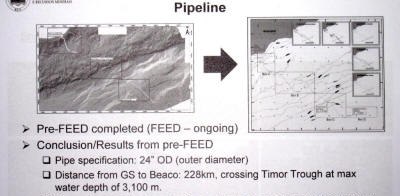
From
Government presentations
Click on each graphic to see it larger. |
|

Artist's conception of the LNG terminal to be built at Beacu. |
|

General Arrangement for Combined Coastal Harbor Option |
|

The all-day Petroleum Ministry/ANP/TimorGAP/IPG/EITI seminar on
The Role of the New Generation in the Mineral and Petroleum Sector
in Timor-Leste was broadcast live on national television on 13
November 2012.
Click here to see
more of the Sunrise-related slides as a PDF. |
|
 |
|
 |
|
 |
|
 |
The ABC radio and television report (transcript
with comment, audio,
original text) interviewed
Timor-Leste's attorney Pierre-Richard Prosper and an Australia law professor,
provoking subsequent comment from
Australian and
Timor-Leste officials and
extensive coverage in the Timor-Leste media. Many commentators appear not to
understand that Article 12 of
CMATS -- negotiated and signed by Australia and Timor-Leste in 2006 --
outlines a process for either country to withdraw from most of the treaty if a
Sunrise development plan has not been agreed by February 2013. Although
Australia would prefer that Timor-Leste not implement this provision, it would
be less offensive than Australia's secret,
unilateral withdrawal from international treaty mechanisms for resolving
maritime boundary disputes in March 2002, two months before Timor-Leste
became a sovereign state. On 22 October, the
Australian Financial Review reported Mr. Prosper's intention to "light a
fire" to resolve the Sunrise debate, suggesting that "moving monies around the
table" could satisfy all parties' concerns as "anything is commercially viable."
Woodside issued its Third Quarter report to the Australian Stock Exchange on
18 October. The company remains publicly positive on Sunrise
"Following the provision of requested technical data to
the Timor-Leste Government, further discussions were held in Timor-Leste in
September and a timetable agreed with the Timor-Leste Government for the first
of a series of technical workshops. Woodside, its joint venturers and the governments of Timor-Leste and Australia
are aligned in their desire to develop the Greater Sunrise fields. Woodside
believes that through regular, open and constructive dialogue between the
parties a mutually beneficial development outcome can be achieved." The
Company also published an
Sunrise Current Status report, elaborating a little on their
community projects and tax issues. In December, Woodside changed its
representative here. Brendan Augustine, who has represented the
company in Dili since 2009, will rotate to Perth, to be replaced by John Prowse.
During November and December, discussion of the Sunrise and
Tasi Mane projects increased in Dili
and Suai, with the Government organizing workshops and seminars to increase
information about and support for the project. Unfortunately, detailed
information and facts to support claimed benefits were usually not presented.
Since public
understanding of the Sunrise project is limited, it is often difficult for
journalists, citizens, and civil society groups to develop informed views on how
it should proceed. Most discussion focused on the first component of the Tasi
Mane project, the Suai Supply Base, for which community consultations are
already underway. Petroleum Minister Alfredo Pires stated that the Tasi Mane
Project will
provide 40,000 jobs for Timorese workers, although he declined to explain
further. He also claimed that the Suai Supply Base, Betano refinery and South
Coast highway are worth doing regardless of whether the Sunrise pipeline
comes to Timor-Leste.
In
one example, on 28 November,
The Australian printed an article quoting Western Australia Premier
Colin Barnett speaking out against floating LNG for Woodside's Browse project
off the coast of Western Australia, which he called "silly" because it would
deprive his state of jobs and domestic gas supplies. Ten days later,
Timor-Leste's government issued a press release
West Australian Premier and BHP
Billiton take same position on FLNG as Timor-Leste which, although
technically accurate, implies that Barnett's opposition to FLNG extends to
Greater Sunrise, which Barnett never mentioned. Timor-Leste newspapers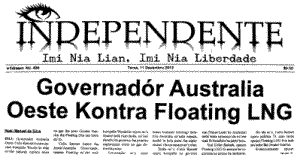 ,
apparently unaware that Greater Sunrise is not the only LNG project in the
world, distorted the issue; the article at right says that
"West Australia Governor Colin Barnett opposes the choice of the company
Woodside which wants to exploit gas from the Greater Sunrise well with Floating
(only above the sea). ... Therefore, Colin Barnett suggests that the company and
the two governments (Timor-Leste and Australia) must look for a solution which
gives benefits to all parties. ... Colin Barnett supports Timor-Leste's policy
because the Floating LNG option will be newly tried at Greater Sunrise."
In reality, Barnett said nothing about Timor-Leste or Sunrise, as he was
commenting on the Browse project. After La'o Hamutuk called it to their
attention, Independente published a
front-page correction on 17
December. On 12 January 2013, the Australian Sunday
Times reported that Barnett's
cause is likely "doomed." (see below)
,
apparently unaware that Greater Sunrise is not the only LNG project in the
world, distorted the issue; the article at right says that
"West Australia Governor Colin Barnett opposes the choice of the company
Woodside which wants to exploit gas from the Greater Sunrise well with Floating
(only above the sea). ... Therefore, Colin Barnett suggests that the company and
the two governments (Timor-Leste and Australia) must look for a solution which
gives benefits to all parties. ... Colin Barnett supports Timor-Leste's policy
because the Floating LNG option will be newly tried at Greater Sunrise."
In reality, Barnett said nothing about Timor-Leste or Sunrise, as he was
commenting on the Browse project. After La'o Hamutuk called it to their
attention, Independente published a
front-page correction on 17
December. On 12 January 2013, the Australian Sunday
Times reported that Barnett's
cause is likely "doomed." (see below)
On 10 December, the
Malaysian Star reported that the company Petro-Mekong Sdn Bhd "said it
is set to finalise a technical collaboration with its international partners,"
including the Timorese company Nexus Meridian LDA and others, for the
"multi-billion ringgit deep sea gas pipeline project in Timor-Leste."
Articles harshly critical of Timor-Leste's position have begun to appear,
leading some to wonder whether there is an organized campaign to discredit this
country. On 26 November, anonymous oil industry blogger Slugcatcher wrote
Sun setting on Sunrise? claiming
that the "inflexible attitude" of Timor-Leste's government, including assertive
efforts to collect back taxes, could scare
off
oil companies from investing in Timor-Leste. In early December,
Timorese businessman Vicente Maubocy wrote in local newspapers questioning the
Lack of Proportion and
Rationality of Megaproject Tasi Mane. In addition to personal attacks
against Petroleum Minister Alfredo Pires, Maubocy suggests that the only way Timor-Leste
could bring the Sunrise pipeline here would be to buy out the operators for $4-$6 billion
(which Australia must agree to) and pay Australia 50% of the expected tax
revenue, which he estimates would cost $13 billion.
La'o Hamutuk disagrees with the tone of the Slugcatcher and Maubocy articles,
and we doubt the accuracy of some of their claims. However, we continue to
believe that a concrete, detailed, fact-based, public discussion of the costs
and benefits of the Sunrise pipeline and Tasi Mane project are critical to
Timor-Leste's future, before billions of dollars are added to the more than $15
million which Timor-Leste has already spent to prepare for south coast petroleum infrastructure. We hope it will
begin soon.
Following approval by the
Council of Ministers on 5 December 2012,
Timor-Leste formally ratified
the UN Convention on the Law of the Sea
(UNCLOS) on 27 December, becoming
an official party on 8 January
2013. Although RDTL had
ratified the Vienna Convention on
the Law of Treaties eight years ago, formal accession was registered the
same day.
 2013
2013
On
25 January, Petroleum Minister Alfredo Pires told local journalists that
Timor-Leste expected to withdraw from the CMATS treaty, but would continue to
push for the Sunrise Pipeline and for maritime boundaries. Dili newspapers
headlined this announcement on 28 January as shown at left, but many of the
articles garbled the facts and confused their readers. A few days later,
Minister Pires clarified that neither Australia nor Timor-Leste had decided yet
whether to terminate CMATS.
More current information on CMATS Treaty developments is on
this page.
 The
lead editorial in the March 2013
Petroleum Economist magazine, entitled "Going
for Broke," discusses the failure of Timor-Leste's oil revenues to
improve the lives of our people, observing former "poster child" Timor-Leste
now resembles a "problem child." The highly-respected, 80-year-old
publication, for which subscribers pay more than $2,000 per year, urges
Prime Minister Xanana Gusmão to "to put national pride
to one side. He must be pragmatic and focus on ensuring Sunrise is developed
and the revenues are used to underwrite the sustainable, long-term
development of Timor-Leste’s non-oil economy. If this does not come to pass,
it is hard to avoid the conclusion that Timor-Leste is a failed
state-in-waiting."
The
lead editorial in the March 2013
Petroleum Economist magazine, entitled "Going
for Broke," discusses the failure of Timor-Leste's oil revenues to
improve the lives of our people, observing former "poster child" Timor-Leste
now resembles a "problem child." The highly-respected, 80-year-old
publication, for which subscribers pay more than $2,000 per year, urges
Prime Minister Xanana Gusmão to "to put national pride
to one side. He must be pragmatic and focus on ensuring Sunrise is developed
and the revenues are used to underwrite the sustainable, long-term
development of Timor-Leste’s non-oil economy. If this does not come to pass,
it is hard to avoid the conclusion that Timor-Leste is a failed
state-in-waiting."
At the end of February, President Taur Matan
Ruak promulgated Timor-Leste's General
State Budget for 2013, with reduced Tasi Mane appropriations compared to the
Government's proposed budget. Infrastructure Fund allocations include the
following lines relating to Greater Sunrise and the Tasi Mane southwest coast
petroleum infrastructure project (all figures in millions of U.S. dollars),
although nothing is allocated to the LNG plant, pipeline construction or
refinery construction. No
information is available on expenditures after 2017.
|
Item |
Spent in 2011 |
Spent in 2012 |
Budget fr 2013 |
Budget fr 2014 |
Budget fr 2015 |
Budget fr 2016 |
Budget fr 2017 |
|
Suai-Beacu highway (including loans) |
1.0 |
|
34.0 |
25.0 |
35.0 |
45.0 |
55.0 |
|
Infrastructure in Beacu |
5.5 |
4.0 |
1.2 |
8.0 |
? |
? |
? |
|
Pipeline route analysis |
0.4 |
2.0 |
1.1 |
1.0 |
|
|
|
|
Suai supply base & airport |
1.8 |
11.6 |
98.1 |
75.0 |
100.0 |
150.0 |
200.0 |
|
Betano refinery |
0 |
2.5 |
3.6 |
5.0 |
? |
? |
? |
|
EIA for Tasi Mane project |
0 |
1.4 |
1.4 |
|
|
|
|
|
Other Tasi Mane project elements |
0 |
1.0 |
14.1 |
20.0 |
20.0+ |
7.5+ |
? |
|
Tasi Mane annual total |
8.7 |
21.6 |
139.4 |
134.0 |
155.0+ |
202.5+ |
255.0+ |
Woodside released their 2012 Annual Report (Sunrise
pages) at the end of February 2013, saying that "Woodside
and the Sunrise Joint Venture are actively engaging with both the Timor-Leste
and Australian governments to achieve an aligned development outcome for Greater
Sunrise." In his briefing on the year's results, Woodside CEO Peter
Coleman reported that "On Sunrise, we have had a number of
productive technical engagements with the Timor-Leste Government in recent
months and I’m pleased we have been able to build on our relationship in order
to share this information. Although this engagement does not represent any
agreement at this stage, we continue to build on dialogue with both governments
to agree on a development which satisfies the requirements of all parties."
The March 2013
Sunrise Status report on Woodside's website reiterated the upbeat tone.
On 28 March,
The Global Mail published Hamish McDonald's comprehensive article about
petroleum history between Timor-Leste and Australia, including Sunrise:
It’s Tiny, Poor, And Very Possibly Not
Going To Take It Anymore. On April 1, Tempo Semanal published
Vicente Maubocy's Are there Obstacles to
a Pipeline from Sunrise to the Shores of Timor-Leste?
On 12 April 2013, Woodside revised its development
ideas for the Browse gas field,
cancelling the James Price Point LNG plant to explore FLNG and other
options, as explained by media
reports (see above for background).
On 18 April, Woodside reported to the Australian Stock Exchange that
"Woodside has held several engagements in Q1 with [Sunrise
LNG] stakeholders from the Australian and Timor Leste governments. Although
these engagements do not represent any agreement at this stage, the dialogue
continues developing common ground with both governments to agree a way forward.
The collaborative effort will continue, engaging on all aspects of the
development." The following week, Woodside Chairman Michael Chaney told
the company's Annual General Meeting that "Woodside and
the Sunrise Joint Venture continued to actively engage with both the Timor-Leste
and Australian governments to achieve an aligned development outcome for Greater
Sunrise. We shall continue to build on dialogue with both governments to reach
agreement on a development which satisfies the requirements of all parties."
Also on 18 April, Timor-Leste's government issued a press release
Emerging data says FLNG a costly risk for Timor-Leste,
citing a new study commissioned by Timor-Leste. This release and the Woodside
AGM prompted an AFR article
on 25 April.
On 23 April, Timor-Leste's government formally notified Australia that it was
exercising its right to arbitration under
Annex
B of the Timor Sea Treaty, arguing that
CMATS
is invalid because Australia conducted espionage in 2004 and did not negotiate
the treaty in good faith. Appointing the three arbitrators could take six
months, and the panel will have another six months to issue a ruling. The
Australian
government and media
(also audio) reported this
on 3 May. On 6 May, Timor-Leste
Petroleum Minister Alfredo Pires (also
audio) explained his
reasoning, and the
business press reported corporate reactions. More detailed and updated
information is on our web page on
maritime boundaries.
The Australian Parliament began an
inquiry (all 73 submissions
available here) on Australia's relationship with Timor-Leste, although it
was suspended due to the mid-year election and change of government. Submissions
from La'o Hamutuk, the
Timor Sea Justice Campaign,
Robert King,
Damien Kingsbury and many
others urged Australia to respect Timor-Leste's sovereignty regarding maritime
boundaries. Oil companies also made submissions, including the
Sunrise Joint Venture
and its members Woodside,
Shell,
ConocoPhillips and
Osaka Gas. As the
Joint Venture wrote: "The Joint Venture respects the right
of the Timor-Leste Government and its peoples to benefit from the development of
Greater Sunrise. Commercial and government parties should now focus on building
a stronger understanding of each other’s key requirements in order to reach a
common interpretation of an agreement which allows the development to proceed
and the benefits realised. Alignment between all stakeholders will build a
stable and predictable governance regime which is required to attract investment
now and in the future. This will lead to stronger relationships and delivery of
significant benefits to all parties."
Timor-Leste's Ambassador
to Australia asked for Fairness: " the downstream pipeline
to an on shore (LNG plant) in Beaço the southern coast of Timor-Leste for the
LNG processing... (which) will form part of the infrastructure and economic
development of entire southern coast region," while the company
MEO Australia proposed an
alternative Sunrise development plan, with an LNG plant on the seabed at Tassie
Shoals.
In late August, Woodside
confirmed that it will use floating LNG for its Browse field and continues
to prefer FLNG for Sunrise as well. A few days later,
Timor-Leste offered to invest $800
million in an onshore LNG plant on Timor-Leste's south coast, which was also
reported by ABC television (audio).
In late November 2013, Timor-Leste re-opened the public debate on maritime boundaries,
with possibly illegal Australian actions in 2004 and 2013.
-- extensive details here. At the
same time, ANP President Gualdino da
Silva told the Australian Financial Review that Timor-Leste continues to
prefer an onshore LNG plant in its territory to "unproven" floating technology.
On 10 December, Petroleum Minister
Alfredo Pires told AFR that
Woodside had presented a "Concept Study" for Timor-Leste LNG, and he told
ABC radio (audio)
that Timor-Leste is ready to invest two billion dollars in the project.
2014
See our web page on the CMATS treaty
for detailed information about legal, arbitration, court, diplomatic, polemical,
media and public arenas of the controversy between Timor-Leste and Australia
about espionage, stealing legal documents, and related issues in 2013-2014. We
are not repeating that voluminous material on this web page.
In its 16 October 2014 report to the Australian Stock Exchange on the
June-September quarter, Woodside wrote "During the
quarter, the Timor-Leste and Australian Governments agreed to a six month
adjournment to a dispute relating to the Treaty on Certain Maritime Arrangements
in the Timor Sea while the two governments negotiate toward an acceptable
settlement. Woodside remains committed to developing Greater Sunrise."
Two weeks later, Woodside sent signals that they are willing to consider
building the LNG plant for Greater Sunrise onshore in Timor-Leste, as
reported by the Australian
Financial Review and
Reuters, and the company is discussing this with Timor-Leste officials.
2015
In mid-February, E&P (petroleum trade press) wrote that
Greater Sunrise is Crucial for
Timor Sea Development, apparently unaware of imminent events. Woodside's
2014 annual report (dated 18 February but written before then),
"we continue to engage with the Timor-Leste and
Australian governments to facilitate the timely progression of the Sunrise
development, including discussions on multiple development concepts
including both on and offshore options. ... Woodside remains committed to
developing Greater Sunrise once alignment on a commercial development
concept is achieved."
The report was released at a press conference on 18 February 2015, at which President Peter Coleman announced that economic pressures
have caused Woodside will "shelve" work on Greater Sunrise until sovereignty
and LNG plant location issues are resolved. They are laying off 320 workers
in 2014, with more layoffs expected. However, Coleman received nearly US$7 million in salary in 2014
and the company is still
looking for new places to invest. See
reports by AAP/The
Australian, Reuters,
Upstream and
The West Australian.
Many believe that the announcement is intended to pressure on Timor-Leste to
give in to the company and Australia on a floating LNG plant and not
establishing a maritime boundary.
Dr. Rui Araujo,
Timor-Leste's new Prime Minister, stressed that he wanted to discuss issues
with Australia "in an honest and friendly way," and does not want
Australian charity. His
spokesperson confirmed that Araujo will continue the previous government's
position for maritime boundaries and a Sunrise pipeline to Timor-Leste's
south coast. As the
industry press exaggerated the significance of Woodside's recent
announcement,
Timor-Leste's Minister of Petroleum said his country was ready to buy
Woodside's share in the project.
On 10 March, Timor-Leste's National Procurement Commission announced its
Intent to Award a $3.8 million
contract to Foster Wheeler Energy Ltd from the U.K. for the "Pre-FEED"
preliminary engineering design for the LNG plant in Beaçu. The Commission
decided against a $5 million bid by WorleyParsons, and will respond to
written protests received by 18 March.
Petroleum Minister Alfredo Pires spoke at the Australasian Oil & Gas
Exhibition and Conference in Perth on 12 March, where he discussed the
terrorism dangers of
Floating LNG and his
unhappiness with Woodside's shelving the Sunrise project, reiterating
Timor-Leste's readiness
to buy out "any disenchanted partners" in Sunrise. The next day,
Woodside responded that
they still prefer floating LNG for Sunrise.
On 17 March 2015, La'o Hamutuk wrote a
letter of protest to the
National Procurement Commission regarding their intent to award a contract
for preliminary design of the LNG
Plant in Beacu. We explained that uncertainties around
the Greater Sunrise pipeline, as well as the many years which will pass before this
project is built, make it inadvisable to spend even more of Timor-Leste's
people's money on the
Beaçu LNG dream. Our blog summarized the letter:
Stop spending good money on faint hopes for Beaçu LNG.
In April, Petroleum Economist's
Time ticking for
Timor-Leste as Sunrise shelved analyzed and summarized Timor-Leste's
dilemma.
Woodside CEO Peter Coleman to a more diplomatic tone when he
addressed the company's Annual Meeting on 16 April:
"On Sunrise, I think we can expect to see some real
progress once clear title and fiscal terms are established."
This page is no longer being updated. For more recent developments, see the
links listed below.
Links
For more information, see these other relevant web
pages:


