 | La’o Hamutuk |  |
 | Reference | Presentations | Mission Statement | LH Blog | Search | Home |  |
|
The La’o Hamutuk Bulletin Vol. 5, No. 2: March 2004Bahasa Indonesia Printable PDF Issue focus: East Timor Government’s Budget Deficit Table of contents:
Seven Ways to Meet East Timor’s Financial Gap
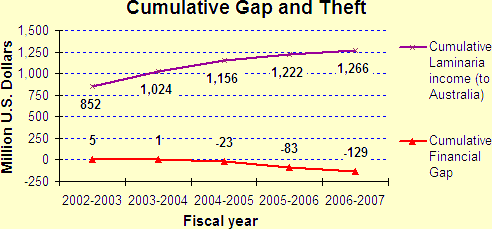
Why is there a budget deficit? A budget deficit is a worrying situation for East Timor, particularly bearing in mind the following factors: the international community has spent a massive amount of money in East Timor since 1999; international experts from the United Nations, aid agencies and international finance institutions ran the country until 2002 and continue to maintain a significant advisory presence; East Timor will soon have access to very lucrative natural resources in the Timor Sea. The two questions are: How can this country bridge the budget shortfall? and Why, at this point, is this country unable to finance its own, modest national budget? Donors and the East Timorese government identified the budget shortfall more than a year ago. La’o Hamutuk reported on future problems for the national budget due to technical problems in the Bayu-Undan field in August last year (See LH Bulletin Vol. 4, Nos. 3-4). However, the real reason for the budget shortfall is that East Timor has been prevented from receiving revenues from the Laminaria-Corallina oil field, which belongs to East Timor under the United Nations Convention on the Law of the Sea principles. Australia has taken in more than $1 billion in revenues from Laminaria-Corallina, enough to cover the budget shortfall eight times over. Moreover, as East Timor’s oil revenue will come primarily from one field, Bayu-Undan, the country will remain vulnerable to scheduling or production problems with that field.
Some fault needs to be apportioned to the international planners who based East Timor’s long term revenue projections on the planned schedule of ConocoPhillips. Oil company schedules are not firm projections. If international advisors understood more about oil industry practice, perhaps East Timor’s government could have prepared for the budgetary difficulties and asked donors to extend their support three years ago. In the meantime, the world has undergone enormous changes, particularly the tragic events of 11 September 2001 and the subsequent U.S.-led wars in Afghanistan and Iraq. East Timor is fading in urgency and awareness, and donor priorities now lie elsewhere. The approximately $3 billion spent by the international community for the reconstruction of East Timor since 1999 has had a negligible effect on the local economy. A large proportion of the money was not actually spent in East Timor, but instead paid for international Peacekeeping Forces and UN police. Foreign consultants, wages for international staff, foreign contractors and supplies procured from outside of East Timor account for much of the rest. The Proposed Options In this article, we will attempt to analyze the seven methods for closing the gap which have been proposed for discussion by the government and the international financial institutions. No single option is a solution. It is not possible to choose one and leave the rest, and a combination must be applied. The first suggestion is for the government to reduce the current expenditure budget. Remembering that living costs in East Timor are high, cutting spending would mean reducing the number of civil servants or cutting salaries; the government spends $27.25 million on 17,150 civil servants, making an average monthly salary of $132. Further cuts could be made in services like heath and education, or by reducing transportation costs. There is not a lot of room to cut government spending without a very negative impact on essential services. Selling vehicles donated by the UN is the second idea. The government is currently trying to sell 600 Tata Sumos in East Timor for $1,000-$3,000 each. It has 400 Land Rovers for sale outside for approximately $6,000 each. Although the government estimates a revenue of $4.2 million from vehicle sales, IMF predictions are much lower at $1 million. The third possibility is for donors to continue or increase their budgetary support through the World Bank-monitored Transition Support Program (TSP) which commenced in 2002. At the international donors meeting in December 2003, the government urged donors to extend their support for the TSP beyond the initial three year time frame (2002-2005) to 2008. If donors continue at the requested level of support ($25 million 2004-5 and $18 million 2005-6), it will reduce the deficit by $43 million. Realigning bilateral and multilateral support according to government priorities as defined in the Sectoral Expenditure Program (SEP) (also called the Sector Investment Program (SIP)) is the fourth option. According to the Register of External Assistance, ongoing and planned bilateral and multilateral projects amounted to over $230 million. SEP is a breakdown of necessary investment and expenditure by sector. SEP covers education and training; health; agriculture and livestock; natural resources and the environment; communications; power; transportation; water supply and sanitation; and private sector development. By coordinating bilateral and multilateral donor projects more closely with priorities outlined in the National Development Plan, the government hopes to use donor funds to substitute for some of the expenses currently in the national budget. The fifth idea is to increase internally generated revenues, currently approximately $20 million per year. While this might be possible, it is unlikely to have a large impact. The current tax base is small and the government must balance the pros and cons of raising import and export tariffs with the economic impact. Importantly, most highly-paid people who could contribute the most to the national budget through income tax are wage tax-exempt, including UN staff, UN contractors, consultants, diplomats, or international employees of international institutions. The sixth option is to use oil money from the Timor Sea reserve account, which currently contains $13.8 million and could increase to $90 million by 2007. Taxes on Timor Sea operations are already used as part of the government budget, but royalties (rent paid to East Timor for oil and gas extracted and sold) are planned to be saved to provide for future generations. At present, there are no regulations for this reserve, and the money is kept in a separate account in the Banking and Payments Authority, to be transferred into the future oil reserve fund. It is possible to use this money to make up the budget shortfall, but it would be a dangerous precedent, contradicting the government’s stated commitment to save and invest East Timor’s petroleum entitlement for a time after all the oil has been sold. Without legal protection, the long-term future of East Timor could be squandered to solve a short-term problem.
The seventh possibility is to borrow money, probably from the World Bank or Asian Development Bank (ADB). The IMF can also make loans to cover temporary budget deficits. All loans to poorer developing countries like East Timor have conditions which have to be incorporated into development plans like the World Bank’s Poverty Reduction Strategy Paper (PRSP), or ADB’s Country Assistance Program. The World Bank has stated that East Timor would not need a PRSP, since it already has the National Development Plan. However, if East Timor borrows, the World Bank would have much greater influence in the design and implementation of policy to meet priorities in the National Development Plan. Each year the government defines targets for its actions. The World Bank monitors the government’s progress in meeting its targets, as part of the Transition Support Program. Borrowing money would essentially extend this process for the duration of the loan and give the World Bank a much greater say in how the government designs and implements its national budget. Conclusion The international community has a responsibility to support East Timor over the long term. For 24 years, the international community enabled Indonesia’s brutal occupation — and nations such as Indonesia, Australia and the United States actively supported it. The community of nations has not condemned Australia’s bullying tactics in the Timor Sea or intransigence in negotiations on the maritime boundary. The Laminaria-Corallina oil field, East Timorese under international principles, is nearing the end of its productive life. It has already paid over $1 billion dollars into the Australian national treasury. This is East Timor’s money and would eliminate the financial gap. If it were available, East Timor would not be facing decisions about cutting essential services or going into debt less than two years after independence.
Australia’s DistortionsOn Australia’s national day, East Timor’s supporters contacted the Australian government to encourage it to respect East Timor’s sovereignty. Australia often replied, explaining their views and distorting the facts. One example is below. The text of this letter is accurate and complete, the layout is a simulation.
Maritime Boundaries Slow in ComingAs La’o Hamutuk has written before (see, for example, LH Bulletin Vol. 4, No. 3-4), the majority of oil and gas resources that should belong to East Timor under international legal principles are under Australian occupation pending agreement on a permanent maritime boundary, and Australia has taken in substantial revenue from them since 1999.
The first round of boundary talks took place in Darwin last November 12, more than a year later. East Timor asked for monthly meetings until boundaries are settled, but Australia will only meet every six months, claiming they don’t have enough people or money to meet more often. See previous page for Australia’s position, and the distortions they tell to defend it. In December 2003, La’o Hamutuk told the Development Partners (Donor’s) Meeting: … the economic stability of Timor Leste requires that we receive full legal entitlement to our resources. We continue to be discouraged by Australia’s eagerness to steal our oil and gas, as symbolized by the rapid depletion of the Laminaria-Corallina oil field. This field would belong to Timor-Leste under UNCLOS principles, but Australia has received approximately one billion U.S. dollars from it since 1999, making Timor-Leste the largest foreign contributor to Australia’s national budget. Since Australia’s uncooperative approach to the talks, East Timor’s government has been encouraging a multi-faceted campaign, as La’o Hamutuk and others have urged for several years. Prime Minister Mari Alkatiri has asked Australia to refrain from exploiting petroleum resources or signing new contracts in disputed areas (a request Australia has ignored); East Timorese officials and diplomats are publicly challenging Australia’s intransigence; the Prime Minister’s Timor Sea Office is reaching out to media and has set up a web site (www.timorseaoffice.gov.tp for latest version on-line). Together with solidarity activists in Australia, the United States and around the world, La’o Hamutuk has been encouraging and facilitating a worldwide campaign to pressure and shame Australia into respecting East Timor’s nationhood. Just before the November talks, more than 100 organizations from 19 countries wrote to Australian Prime Minister John Howard, urging his government to set a firm timetable for establishing a permanent maritime boundary within three years, and to treat East Timor “fairly and as a sovereign nation, with the same rights as Australia.” The Australian government replied that “the process [of delimiting maritime boundaries] is long and complex. Based on this experience, the Australian Government does not think it sensible to set an end-date for the process.” Australia also “has no plans to revisit its decision in March 2002 to no longer accept the jurisdiction of the International Court of Justice and other dispute settlement mechanisms…” Many Australian people feel otherwise, and have launched a Timor Sea Justice Campaign, initially in Melbourne. The group is calling on the Australian Government to:
Australia celebrated its national day on 26 January, the 216th anniversary of the first British settlement in Australia. In East Timor and around the world, people argued and pleaded with Canberra to treat East Timor seriously.
The Oilwatch Network, headquartered in Ecuador, is supporting East Timor’s efforts to secure our resource birthright, while simultaneously helping us learn about, and hopefully avoid, the “resource curse” which brings poverty, corruption, destruction and conflict to so many oil-rich nations. La’o Hamutuk participated in the Oilwatch biannual general meeting in Colombia last September, and worked with Oilwatch to organize the East Timor-Nigeria exchange in January (full report in next Bulletin). Together with East Timor’s Independent Information Center on the Timor Sea (CIITT), we participated in an organizing meeting for Oilwatch Southeast Asia in Bangkok in February, and will continue to work closely with this network of the Global South, linking people in petroleum-rich tropical forest countries around the world. Bayu-Undan, the largest oil and gas field in the Timor Sea’s Joint Development Area, began test production in February, although it will be many months before economically significant oil can be sold (see article on Financial Gap). Over the next few months, La’o Hamutuk will continue to monitor activities there, as well as analyze plans to use and save revenues from East Timor’s oil entitlement.
The Gas & Oil Industry: Victimized Communities Protest Unmet PromisesIn February, Selma Hayati (La’o Hamutuk) and Marcelino Magno (representing the Independent Center for Timor Sea Information - CIITT) participated in a meeting of Oilwatch Southeast Asia, a network of civil society groups monitoring the exploitation of natural gas and oil resources. The 8-year-old Oilwatch Network, headquartered in Ecuador and represented in East Timor by La’o Hamutuk, unites people from tropical forest countries around the world to resist the negative political, environmental, economic and social consequences of the petroleum industry. The consultation, organized by the Campaign for Alternative Industry Network (CAIN), Greenpeace Southeast Asia, and Earth Rights International (ERI), was held in Bangkok, Thailand, on 14-16 February, 2004, and was attended by 18 NGOs. Its theme was The Moratorium on Oil and Gas Development. The meeting was also attended by Thai community representatives from the Chana district in Songkhla province, Rayong, Chonburi, Petchaburi, and the Thailand-Malaysia Village Community Alliance who are affected by the Thai-Malaysian gas pipeline project. The two-day meeting discussed important issues from each of the participants’ six countries, including the involvement of the military in the petroleum industry, the trans-ASEAN gas pipeline project, alternative energy, environmental issues, and human rights violations caused by oil and gas development. Many community representatives attended, including the Arakan tribe (from West Burma invaded by Burma in 1784, Britain in 1824, and now under the repressive military junta), who have suffered as a direct result of oil and gas exploitation. They were promised a better life from the gas, but in reality their rights were violated and they did not get anything. The meeting ended with an excursion to the gas pipeline project on the Thailand-Burma border in Kanchanaburi, where we trekked three kilometers into the forest for almost four hours, to trace the Burma-Thailand-Malaysia pipeline which cuts through the Chana community area. The following are important issues that the Southeast Asia Oilwatch network will give serious attention to, with the support of the secretariat of Oilwatch International: Military As Guard Dog for Companies Thailand, Burma and Indonesia are well-known for using their militaries to safeguard the profitability of the oil and gas industry. Armies have actively participated in the Yadana/Yetagun pipeline project in Arakan, Burma, and the Thailand-Malaysia Joint Development Area (JDA) pipeline project, as well as in Aceh and West Papua in Indonesia. Military involvement begins with preliminary land-clearing and continues all the way to post-development, always in the name of community welfare and national security. The results of military involvement in these three countries are similar: violence through intimidation, torture, shooting, arrests, sexual abuse within the industrial areas, restriction of movement, forced migration, and an unfair legislation. For example, the Thai military attacked, shot and arrested members of the Chana community in Songkhla province on 20 December 2002; Burma has increased its military presence in Arakan to 30,000 soldiers in 54 battalions; Indonesian troops provide security for the area and operations of ExxonMobil in Aceh and Freeport in West Papua. Negative Environmental and Social Consequences “… There is not much that we can still catch in the sea.” So says Horha Sansuwan, a fisherman from Ban Lae village, 500 meters from the Songkhla Sea Harbor in Thailand. Sansuwan testified to the environmental changes resulting from the offshore project, which changed the beach and ocean ecosystem and damaged the local fishing industry. In the meantime, it has also changed the shape of the shoreline from erosion. The Arakan experience also demonstrates that chemicals used by offshore oil projects can severely affect the health of coastal residents. The development of pipelines and oil and gas industry in coastal areas changed the livelihood and severely reduced community income in communities near the Map Ta Phut Free Trade Zone in Rayong province, Thailand. These communities used to depend on fishing, but since their income fell, most of the younger residents now seek industrial work as laborers. For the past four years, several large industries have severely damaged their health, with fumes and bad smells causing breathing difficulties. What happened to the benefits that the government and business owners promised? Another example is the environmental changes in the Kanchanaburi area, crossed by the Thai-Malaysia gas pipeline. The damage to the earth and vegetation have caused the elephants to avoid the forests around the area, made protective topsoil vegetation disappear, and done other damage to the ecosystem. Trans ASEAN Gas Pipeline The regional economy within ASEAN requires construction of a regional energy network. In an agreement between several ASEAN member states and other industrialized Asian nations like Japan, Korea, Taiwan, and China (ASEAN Action Plan in Energy Cooperation 1999-2004), it was proposed to build a 10,000 km long Trans-ASEAN pipeline through Indonesia, Malaysia, Singapore, Thailand, and the Philippines. We can predict the impacts of this project after observing the Yadana and Thai-Malaysia pipeline projects: land rights conflicts and environmental damage, both within and on the states’ borders. Alternative Energy It is important for the government and people of East Timor to think about alternative energy, which could reduce our dependence on oil and gas resources and create environmentally friendly energy. The development of alternative energy can be done by promoting energy conservation and sustainable energy. There needs to be a dissemination of information about alternative energy, and we can take advantage of small scale traditional energy solutions: biogas, mini hydro-electric plants, biodiesel, ethanol, etc. as well as a comprehensive waste management. One general obstacle for alternative energy development is the dependence on expensive foreign technology. We need to take time to understand the importance of alternative energy, because this is not merely a matter of policy. Keep Organizing: Lessons for the People of East Timor The development of oil and gas in the Timor Sea is different from the cases mentioned above. However, East Timorese people can learn good lessons from the experiences of those countries. The local resistance in Thailand, Indonesia, Malaysia, and Burma, built on strong grassroots organization, are a good example. A strong local network and shared community interests can help the East Timorese people be more effective dealing with the maritime boundary issues with Australia. East Timorese people still need to realize that Timor Sea oil and gas is not only an issue for NGOs and the government of RDTL, but is a matter for all of us. Alisa Manlah: “Welfare? We Did Not Get Anything!”
A moral responsibility as a Muslim was her preliminary commitment, when she saw with her own eyes how the food stalls in Rayong province, Thailand, became karaoke and underage prostitution sites. From then on, she began to read and search for information, discussing the negative impact of the oil pipeline crossing her village, and organizing herself and her neighbors, together with people from other villages. Death threats and a government-imposed travel ban did not quench her fire. “The law did not side with us. The military and the police had helped the oil companies. The companies (Petronas - Malaysia and Petroleum Authority of Thailand - PTT), far stronger than our government, are dictating to the government. We did not get anything. Where is the benefit? This is a matter concerning justice that we are fighting for!” she said sternly. During a protest on 12 December 2002, 20 of her friends were arrested and scores more were injured by the shots and beatings from 600 policemen. The project is continuing. The eight villages in Songkhla province still resist. Alisa and her friends moved into the jungle to oppose the project, and eventually their camps in the forest forced the project to halt. “The government will no doubt try to continue with its project, but we will still fight for our rights,” she said. |
The Timor-Leste Institute for Development Monitoring and Analysis (La’o Hamutuk) |

 The ‘financial gap’ in East Timor is not a gap but a budget deficit over the next four years currently estimated at US$126.3 million until oil and gas revenues come on stream in 2007. This means that the government won’t have enough money to cover its expenses over this period. The most important and immediate consequence is that the government may not be able to afford basic services, which can lead to instability.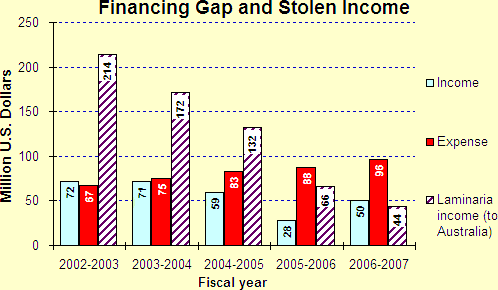

 AUSTRALIAN HIGH COMMISSION: LONDON
 Nearly two years ago,
 Her face, always covered by the Islamic hijab, always radiates a smile and her words are firm. Alisa Manlah, a.k.a Rofiah (her Islamic name), is only one of the strong women of Chana who are currently struggling to resist the gas pipeline between Thailand and Malaysia.