
November 2004
Background | Energy | Oil | Natural Gas | Coal | Electric Power | Profile | Links
Australia
Australia is the world’s leading coal exporter. Although there is more exploration yet to be done, Australia ’s proven oil and natural gas reserves have nearly doubled in recent years. The government is currently in the process of developing infrastructure to bring more of Australia ’s natural gas reserves to market.
Note: Information contained in this report is the best available as of November 2004 and is subject to change.
 BACKGROUND
Australia has exhibited robust economic growth over the last decade, most recently with a 3.0% increase in real gross domestic product (GDP) in 2003 and a forecast 3.7% increase in 2004. As a result, Australia is one of the world’s fastest growing industrialized countries. Such growth has occurred in spite of weak export demand and a strong Australian dollar that has depressed exports, as well as severe droughts during 2002 and 2003.
Australia ’s Liberal Party, under Prime Minister John Howard, has led the country since 1996, recently winning reelection on October 9, 2004 . During its tenure, the Liberal Party has focused on stimulating domestic consumption by overhauling the tax system and cutting interest rates. Expansionary fiscal policy, as well as the deregulation of many domestic markets, has fostered significant increases in domestic consumption in recent years.
ENERGY
Australia is an energy resource-rich country with significant petroleum, natural gas and coal reserves. Australia ’s energy consumption is dominated by coal, which fuels most of the country’s power generation. Petroleum also accounts for a large share of energy consumption. Natural gas use is relatively small, but it has been growing rapidly in recent years. As a result of expanding consumption in a period of declining production, Australia is facing growing dependence on petroleum imports. Although foreign investment in the energy sector remains high, many Australians believe that a restrictive regulatory climate and the government’s failure to provide incentives for potential investors have lessened further growth. In 2003, for example, several US-based companies made plans to sell their Australian pipeline assets as a result of the regulatory climate.
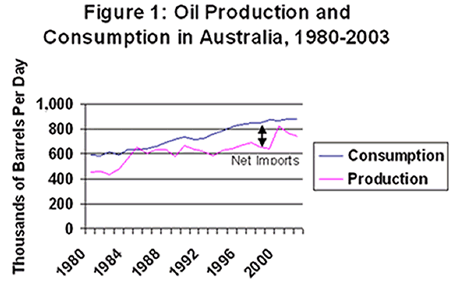
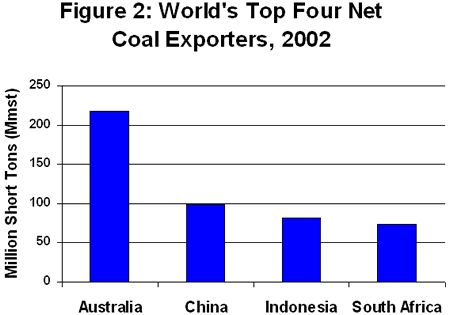
Australia is one of the few OECD countries that is a significant net energy exporter (see Figure 1). It has been the world’s largest coal exporter since 1986 (see Figure 2), and it is the sixth largest exporter of LNG. Australia ’s prospects for expanding energy exports in the future are promising, as Asian demand for both coal and LNG rises. In the future, Australia can expect increasing export competition from China , in coal, and Indonesia , in both coal and LNG. Japan , the largest importer of Australian coal, is considering taxing coal imports to encourage consumption of other fuels. As a result, long term growth of Australia ’s coal exports is contingent on Asia ’s response to global warming concerns.
In June 2004, the Australian government issued “Securing Australia’s Energy Future,” commonly known as the “White Paper,” which forecast that energy demands will grow 50% by 2020. The paper’s endorsement of the increased use of coal has been controversial with the Australian public and environmental lobbies, especially since the recently reelected government has made no commitment to ratify the Kyoto Treaty.
 OIL
OIL
Australia ’s oil reserves, mostly located offshore of the northwestern and southeastern parts of the country, are estimated at 3.5 billion barrels (Oil and Gas Journal, 1/1/04 ), a 20% increase over 2001 reserves. The two largest areas with petroleum reserves are the Bass Strait off southern Australia , with 1.8 billion barrels, and the Carnarvon Basin off Western Australia , with 1.1 billion barrels.
Exploration and Production
Declining petroleum production as fields mature, coupled with climbing domestic oil consumption, has increased concerns in recent years about growing insufficiency of the Australia’s fuel supply. As a result, the government has responded with issuances of new exploration permits. In March 2003, the government opened bidding for exploration permits in 35 new offshore areas, 22 in the Northern Territory and Western Australia and the remaining scattered around southern Australia , including Tasmania and the Ashmore and Cartier Islands . The next licensing round is set to occur between now and March 2005, with 21 blocks being offered for exploration.
Prospects for new petroleum finds in Western Australia are considered promising following discoveries by Woodside Petroleum and BHP Billiton in February 2003. ConocoPhillips plans to develop two fields in the Timor Sea , Zoca and Coleraine, with reserves at 150 million barrels. The Mutineer/Exeter oilfield in the Carnarvon Basin , with estimated reserves of 101 million barrels, is the next field expected to come onstream in 2005, but it will not reach full production until 2006.
Interest in exploration off Southern Australia is led by Australian-based Santos, Inc., who identified recoverable reserves at its Casino site of 200 Bcf. Production at the Casino site is slated to begin in 2006. Because its adverse weather conditions and deeper waters make potential ventures costly, much of the area around Southern Australia has not yet been explored. Furthermore, only four of the 36 wells drilled in Australia ’s deepwaters since 1992 have yielded oil. Australia ’s Woodside Energy abandoned as dry its Gnarlyknots well in the Great Australian Bight in May 2003.
The majority of past petroleum exploration in Australia has been carried out by large domestic oil firms, including BHP Billiton, Woodside Petroleum, and Santos. Current exploration ventures, however, have seen greater participation of smaller Australian companies, as well as increases in foreign interest. In September 2004, for example, Oilex announced the discovery of a find in Queensland ’s Surat Basin expected to have reserves of 12 million barrels.
The country’s existing tax laws are regularly criticized as an obstacle in attracting substantial foreign investment. The Australian government has also made an effort in recent years to pass amendments to cut exploration costs, making a four-year, US$30 million commitment to fund AGSO-Geoscience Australia , a national agency that provides petroleum and natural gas companies with seismic and geological data.
Australia ’s oil production has increased gradually since 1980, peaking in 2000 at 805,000 bbl/d. In 2003, production fell dramatically to 630,522 bbl/d. Declines have been attributed to decreasing production at the Cooper-Eromanga and Gippsland basins. Australia ’s Bureau of Agriculture and Resource Economics (ABARE) estimates that production will fall to 560,000 bbl/d by 2006. Although Australia ’s other major basins, the Carnarvon and Bonaparte, have yielded increasing amounts of oil in recent years, they are unable to meet the country’s rapidly growing demand.
While Australia ’s declining production contributes heavily to the country’s growing oil deficit, expanding petroleum demand exacerbates the situation. In 2003, petroleum consumption averaged 880,000 bbl/d, resulting in net imports of 249,478 bbl/d. By comparison, net oil imports in 2000 averaged only 54,000 bbl/d. Even with the contribution of its own reserves, the Australian Petroleum Production and Exploration Association (APPEA) predicts that oil import dependency will rise to 78% within the next ten years. In 2003, the majority of Australia ’s imported crude came from the UAE, Malaysia , Vietnam , and Papua New Guinea.
Australia has shale oil reserves in Queensland estimated at as high as 30 billion barrels. Until recently, Greenpeace pollution protests prevented the primary developer of Queensland ’s shale oil, Southern Pacific Petroleum/Central Pacific Minerals (SPP/CPM), from utilizing the resource. As a result, every major Australian refining firm refused to purchase Queensland ’s shale oil in 2001, forcing the industry to look to the government for support. In May 2002, the government extended existing excise rebates, originally designed only for the domestic sale of shale oil products, to international markets for 12 months. SPP/CPM secured a long-term contract for the domestic sale of naptha, derived from shale oil, to Mobil Oil Australia two months later.
Refining
Australia has eight refineries, two each owned by four companies, with a total crude oil distillation capacity of 754,975 bbl/d. Four of the refineries are located on the country’s eastern coast, three on the southern coast, and one in Western Australia . Australia ’s refineries are relatively small, the three biggest being: BP’s Australia ’s Kwinana refinery (132,050 bbl/d crude oil capacity); ExxonMobil’s Altona refinery (130,000 bbl/d crude oil capacity); and Shell’s Geelong refinery (110,000 bbl/d crude oil capacity). Australia ’s fourth refining company is Caltex.
All eight refineries have experienced declining gross margins for several years, mainly due to competition from foreign refineries benefiting from economies of scale. An oversupply of refining capacity in Asia coupled with the relatively high cost of transporting crude oil to Australia is another factor hurting the country’s refiners. Australia ’s refineries are equipped only to process light, sweet crude oils, even though heavier, sour crude oils may be cheaper. New fuel quality standards requiring facilities upgrades by 2006 will add to the cost burden. In April 2003, ExxonMobil announced plans to close its 78,000 bbl/d Adelaide refinery, citing poor refining margins. Analysts have forecast additional closures in Australia ’s refining sector in the future.
NATURAL GAS
Australia ’s natural gas reserves are estimated at 90 trillion cubic feet (Tcf), the largest reserve in the Asia Pacific region (2004E). The most abundant reserves are located offshore of the northwestern coast in the Carnavoran Basin (40 Tcf of proven natural gas), an area more well-known as the Northwest Shelf. Other important basins, including the Cooper/Eromanga basin in Central Australia and the Bass/Gippsland basin offshore of southern Australian, account for approximately 10 Tcf of reserves.
Natural gas presently plays a relatively small role in Australia ’s fuel mix (approximately 17%), but consumption has grown steadily, from 710 Bcf in 1995 to 893 Bcf in 2002. Australia ’s natural gas consumption is projected to grow twice as fast as the consumption of other energy sources in the next two decades, and it is expected to account for 24% of total energy consumption by 2020.
Natural gas production in Australia has increased rapidly since 1995, from 690 Bcf to 1.26 Tcf in 2002. Despite declining production capacity in the Cooper/Eromonga Basin, production is expected to grow 3.5% in 2004. An explosion at Santos ’ Moomba gas-processing plant in January 2004 has further affected natural gas production.
The status of abundant reserves in the Timor Sea has been partially resolved. In May 2002, East Timor expanded its maritime territory claim and challenged Australia ’s claim to 25 Tcf of reserves in the Browse/Bonaparte Basin. In March 2003, the Timor Gap Agreement was established, creating a Joint Development Area (JDA) between the countries and setting the division of royalties from hydrocarbon production at 90:10 in favor of East Timor . Only the Bayu Undan natural gas field (3.4 Tcf), which began operation in February 2004, lies wholly within the JDA. Eighty percent of the Greater Sunrise field (9.3 Tcf) is located outside of the JDA. The Timor Sea also contains natural gas in the Evans Shoal, Petrel, and Tern gas fields, estimated to contain 4 Tcf of natural gas combined. ConocoPhillips, Woodside, and Shell are the main operators in the Timor Sea .
Recent natural gas exploration in Australia has resulted in several important discoveries including ExxonMobil’s June 2002 discovery of 20 Tcf of natural gas in the Jansz field of the Northwest Shelf. In 2001, natural gas discoveries were made in Southern Australia 's Otway Basin , raising estimates of that basin’s reserves to 1.6 Tcf. Furthermore, Apache Corporation recently announced that 800 Bcf of reserves had been identified at its John Brookes site. In September 2004, Woodside Petroleum announced a find in the Polkadot-1 exploration well off the northern coast. It is expected to begin production in 2005. Additional natural gas discoveries will likely be made inadvertently as a byproduct of Australia ’s recent surge in petroleum exploration, as past exploration in the deep waters off Southern Australia has primarily resulted in the discovery of natural gas.
Liquefied Natural Gas (LNG)
Liquefied natural gas (LNG) exports have greatly increased Australia ’s natural gas production since it began exporting the commodity in 1989. In 2002, Australia was the world’s sixth largest LNG exporter, accounting for 7% of global LNG exports. Japan is the primary destination of Australia ’s LNG supplies, with smaller shipments to South Korea and Spain . Australia secured contracts to supply LNG to China in 2002 and South Korea in 2003. Initial negotiations began with Mexico in September 2004 in an effort to tap the LNG market on the US West Coast.
Australia ’s natural gas reserves are found in three areas: the Bass Strait , the Cooper/Eromanga Basin, and on its west and northwest coasts. The Northwest Shelf Venture (NSV), a consortium of six energy companies led by Woodside Petroleum, operates three offshore LNG trains. It relies on natural gas supplies from North Rankin (19.3 Tcf) and nearby fields of the Northwest Shelf (NWS). NWS produces 8% of world LNG supplies, mostly for export to Japan . Construction on a fourth train was completed in July 2004. A fifth train has been proposed, but has only received support from Woodside and BHP Billiton. Further support for another train may be influenced by NSV’s winning a bid to supply China ’s Guandong LNG terminal beginning in 2005. The development of pipelines across the western half of the country may allow NWS to supply domestically to Australia ’s southeastern states in the future as well.
Although NSV dominates Australia ’s LNG market, other LNG projects are being developed as well. NSV members ChevronTexaco (57% ownership), Shell (29%) and ExxonMobil (14%) are developing a proposal for the Northwest Shelf's 12.9-Tcf Gorgon field. The project entails the construction of a pipeline to transport natural gas from the Gorgon field to Australia ’s Barrow Island , where a liquefaction plant with an annual capacity of 238 Bcf per year is to be constructed. ChevronTexaco has secured an agreement with an affiliate for the delivery of 95 Bcf per year from the Gorgon Venture to North America over a 20-year period beginning in 2008. In April 2004, Australia began talks with China ’s largest oil firm, CNOOC, to purchase a 12.5% share of Gorgon’s proven reserves. An estimated US$21 billion in sales over 25 years would make such a deal the largest export commitment in Australian history.
ConocoPhillips has proceeded with plans to construct a liquefaction plant on Australia ’s northern coast (at Darwin ) to be supplied by natural gas from the developing Bayu/Undan field (3.4 Tcf) by 2005. ConocoPhillips has a majority interest (64.4%) in the project, which it is developing with Santos (11.83%), Italy 's ENI (12%), and Japan 's Inpex (11.71%). In March 2002, ConocoPhillips arranged to sell 3.6 million tons (convert) of LNG per year from the Darwin plant to Tokyo Electric Power Company and Tokyo Gas Company for 17 years beginning in 2006.
Another LNG project, led by Woodside Petroleum (33%) in a consortium with ConocoPhillips (30%), Royal Dutch/Shell (27%) and Osaka (10%), has been proposed for the Greater Sunrise natural gas field (9 Tcf) in the Timor Sea . The consortium has announced its plans to develop the project by constructing a floating LNG plant with a proposed capacity of 238 Bcf per year. Production is scheduled to begin in 2008.
In May 2004, Woodside and Origin Energy announced their commitment to the development of offshore Otway Basin gas reserves. Construction of the Thylacine gas field will begin this month, while development of the Geographe field will be connected at a later date. Recent announcements of two other projects rely on discoveries from the 1970s. Woodside indicated that Browse, another proposed Australian LNG station, will begin exports by 2011. BHP is considering a floating LNG facility to process the estimated 8 Tcf in its Scarborough reserves, and it announced in September 2004 that Onslow was the preferred site for another facility.
Australia is also a significant exporter of LPG. Because the majority of reserves are located in the Northwest Shelf, however, the country is a net importer of LPG in its southeastern region. LPG consumption has fallen in the last several years, as energy efficiency measures have taken hold; production, however, continues to rise.
Pipelines
Australia ’s existing pipeline infrastructure is fragmented and was built to carry gas from centrally located fields to coastal urban hubs including Sydney and Melbourne. With centrally located fields in decline, however, and offshore projects on the rise, a large investment in the country’s pipeline network will be necessary to bring additional natural gas into the grid. Australia estimates that it will require US$5.5 billion of new investment over ten years to efficiently use natural gas to generate power.
The Australian Pipeline Trust (APT) operates over 4,350 miles of pipelines (oil and gas combined), while Epic Energy operates around 2,485 miles of pipelines (oil and gas combined). Although Australian Gas Light (AGL) is the leading owner of gas pipelines, they are operated by APT.
Ongoing tensions between pipeline companies and regulators may discourage the entry of new investors. For example, Australian Epic Energy put its pipeline assets up for sale in September 2003 after determining that regulated pipeline tariffs were too low for profitable operation. Other companies, including the Australian Pipeline Trust, have halted construction on proposed pipelines due to regulatory environmental concerns. In August 2004, the Australian Pipeline Trust began negotiations with US-based CMS to sell US$158 million of gas pipelines in Western Australia . Many Australian and international investors, as well as the Australian Pipeline Industry Association (APIA), are calling for regulatory reforms to improve the situation.
Duke Energy completed sub sea gas pipelines to link the mainland with Tasmania in both 2002 and 2003. Proposals for more pipelines have been delayed, as both Duke Energy and Epic Energy are in the process of selling pipeline assets. In March 2004, Duke announced the sale of three Australian gas pipelines and three gas-fired power stations to Alinta.
Current proposed natural gas pipeline projects reflect Australia ’s changing supply base, including offshore projects to support the LNG ventures described above. The 423-mile Sea Gas pipeline, which brings natural gas from the Otway Basin to Southern Australia ’s Quarintine power station in Adelaide , was recently completed.
A 1,300-mile proposed pipeline from Papua New Guinea (PNG) to Australia will deliver gas from the Kutubu/Moran natural gas fields in PNG Queensland. Progress on the pipeline has been paralyzed by a lack of commitment from its potential buyers. In February 2004, Oil Search Ltd, the main developer of the pipeline, committed to beginning its design without the requisite funding, noting that gas could flow by 2008 with investment of US$70 million from minority partners.
In January 2004, the Australian government also commissioned a feasibility study on a possible 1,800 mile transcontinental pipeline to ship gas from the Carnarvon and Browse Basins to southeastern domestic markets.
 COAL
COAL
Australia is estimated to contain 90.5 billion short tons (Bst) of coal reserves, the majority of which are concentrated along the country’s eastern seaboard. As a result of several consolidations in recent years, Australia ’s coal industry is dominated by four companies: BHP Billiton; Anglo American (UK); Rio Tinto (Australia-UK); and Xstrata ( Switzerland ). The Bowen Basin in Queensland contains the largest reserves (37.8 Bst). Reserves in the Sydney-Gunnedah Basin and surrounding areas of northern New South Wales (NSW) contain about 32.1 Bst. Minor reserves are also located in Southern and Western Australia as well as Tasmania.
Australia is the world’s fourth largest coal producer. It exports approximately 60% of its annual production, making it the largest net exporter of coal (28% of global coal exports). Together, Queensland and NSW account for 95% of Australia ’s annual coal production. While both states produce both coking and thermal coal, production of coking coal is significantly higher in Queensland , while NSW leads in thermal coal production. Over the last decade, coal production in Australia has grown by 4% annually, reaching 378 million short tons (Mmst) in 2002.
Australia is dominant in the market for coking coal, where it is responsible for over half of all world exports. Australia also leads the world in thermal coal exports, although it accounts for a smaller share of that market (around 21%). Australia ’s thermal coal exports recently began to face new competition from China , raising the possibility that its share of that market may shrink in the future.
Japan is the destination of over 60% of Australia ’s coal exports, while other important export markets include non-Japan Asia and Europe . As a result, Australian suppliers set prices for their coal exports directly with Japanese utilities. As a result, the annually negotiated price of these contracts has a large effect on Australia ’s coal export earnings. In April 2004, the Australian government announced that Japanese electricity producers could pay up to 70% more for Australian coal as a result of rising demand coupled with limited supply. Because China is increasing its domestic coal use and Indonesian output was curtailed by heavy rains, Australia is seen as the main source of a now limited coal supply.
ELECTRIC POWER
As of January 2002, Australia had electric generating capacity equal to 45.3 million kilowatts. Approximately 84% of this capacity was thermal (mostly coal) while 14% was renewables (mostly hydro). Coal-fired generating capacity is primarily located in the eastern part of the country near its coal reserves, while Western and Southern Australia rely on natural gas to fuel their power plants. In 2002, Australia generated 210.3 billion kilowatthours (bkwh) of electricity and consumed 195.6 bkwh. The Energy Supply Association of Australia (ESAA) has predicted that consumption will grow rapidly in coming years, rising to 206 Bkwh by 2008, with the majority of growth in consumption concentrated in Queensland , NSW and Victoria.
Prior to 1996, electric utilities were owned independently by states, but 1996 reforms privatized many state-owned utilities. Key to these reforms was the creation of the National Electricity Market (NEM), a wholesale “pool” operated by the National Electricity Market Management Company (NEMMCO). It serves Queensland , New South Wales , Victoria , Southern Australia , and the Australian Capital Territory via an interconnected national electricity grid. Tasmania , Western Australia , and the Northern Territories are not members of the NEM, although Tasmania is expected to join by 2005 via the Basslink interconnector, a high voltage direct current (HVDC) submarine cable. In November 2002, the government of the state of Western Australia adopted its own plans for reforming its electricity sector by unbundling the state’s regulated utility, Western Power and establishing a wholesale power market by 2005.
Consumer reviews of Australia ’s electricity reforms vary. Overall electricity prices fell approximately 11% between 1996 and 2000, although the majority of the savings went to large industrial/commercial customers. During 2000 and 2001, the NEM experienced a significant increase in price volatility arising from unusual temperature conditions and supply shortages. As a result, retail competition was introduced to NSW and Victoria in January 2002. Due to overcapacity and strong competition, electricity prices have decreased since the states have been combined into a two-state regional market, although prices have recently begun to rise as increasing demand diminishes spare capacity. In Southern Australia , reforms have led to higher prices following the introduction of retail competition in January 2003. Queensland has indefinitely postponed introducing retail competition, a decision that could be indicative of the provincial government's reluctance to abdicate its control over the electric power sector.
The NEM has been successful in encouraging new investment: between 2000 and 2002, 3,300 MW of new generating capacity was added. Rapid growth in demand for electricity has nonetheless resulted in shrinking reserve margins in eastern Australia , a problem that could increase by 2005 without sufficient investment in new generating capacity. The prospects for new foreign investment are limited, however, as several US and UK companies with stakes in Australia ’s generating assets have recently made plans to exit the industry.
ENVIRONMENT
Because energy commodities are a major source of export earnings in Australia , development of these resources in a sustainable manner is a primary policy goal of the government. Improving end-use efficiency in various economic sectors remains a key element of Australia ’s sustainable energy policy, as does the utilization of renewable energy resources. Australia ’s Mandatory Renewable Energy Target (MRET) mandates that an additional 2% of Australia ’s power come from renewable sources by 2010. This mandate led to a proposal by Pacific Hydro, the country’s largest renewables company with a total generating capacity of 112.7 MW, to expand the country’s wind power capacity. In 2003, work also began on the development of Australia ’s first geothermal project in the Cooper Basin , estimated to contain an energy resource equal to 50 billion barrels of oil.
In 2002, Australia accounted for 1.7% of the world’s total energy-related carbon emissions. Although coal constitutes a major part of Australia ’s energy mix, increasing urban air pollution levels are more a consequence of automobile usage than coal consumption.
In February 2004, Enviromission announced an optimistic end to a feasibility study concerning the completion of a 200 MW solar tower in Mildura. Following the announcement, in June 2004, the government pledged A$75 million for “solar cities” trials in urban settings.
COUNTRY OVERVIEW
Prime Minister: John Howard (since 3/11/96)
Independence: January 1, 1901 (from the United Kingdom)
Population: 19,913,144 (July 2004E)
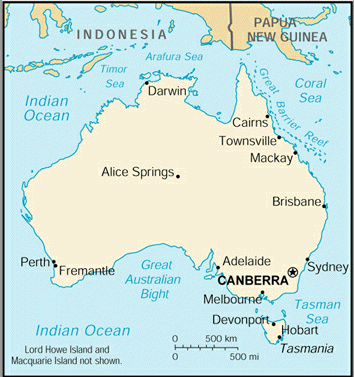
Location/Size: Oceania, continent between the Indian Ocean and the South Pacific Ocean/7,686,850 sq. km (2,971,081 sq. mi), about the size of the contiguous United States
Major Cities: Sydney, Melbourne, Canberra (capital), Brisbane, Perth, Adelaide
Languages: English, native languages
Ethnic Groups: Caucasian (92%), Asian (7%), aboriginal and other (1%)
Religions: Anglican (26%), Catholic (26%), other Christian (24%), non-Christian (11%)
ECONOMIC OVERVIEW
Currency: Australian Dollar ($A)
Market Exchange Rate (10/4/04): US$1=$A1.3875
Nominal Gross Domestic Product (GDP, 2003E): US$506 billion
Real GDP Growth Rate (2003E): 3.0% (2004E): 3.7% (2005F): 3.0%
Inflation Rate(Consumer prices; 2003E): 2.8% (2004E): 2.3% (2005F): 2.6%
Unemployment Rate (2003E): 6.0% (2004E): 5.7%
Current Account Balance (2003E): -$30.1 billion (2004E): -$37.6 billion
Major Trading Partners: Japan, other Far East, European Union, United States
Major Export Products: crude materials, food and live animals, mineral fuels and lubricants
Major Import Products: machinery and transport equipment, manufactured goods, chemicals
ENERGY OVERVIEW
Minister for Industry, Tourism and Resources: Ian E. McFarlane
Proven Oil Reserves (Oil and Gas Journal; 1/1/04E): 3.5 billion barrels
Oil Production (2003E): 630,522 barrels per day (bbl/d), of which 512,250 bbl/d was crude oil
Oil Consumption (2003E): 880,000 bbl/d
Net Oil Imports (2003E): 249,478 bbl/d
Crude Refining Capacity (Oil and Gas Journal; 1/1/04E): 754,975 bbl/d
Natural Gas Reserves (Oil and Gas Journal; 1/1/04E): 90 trillion cubic feet (Tcf)
Natural Gas Production (2001E): 1.3 Tcf
Natural Gas Consumption (2002E): 893 billion cubic feet (Bcf)
Recoverable Coal Reserves (2002E): 90.5 billion short tons
Coal Production (2002E): 377.7 million short tons (Mmst)
Coal Consumption (2002E): 159.6 Mmst
Electric Generation Capacity (2002E): 45.3 million kilowatts (84% thermal, 14% hydroelectric)
Net Electricity Generation (2002E): 210.3 billion kilowatthours (Bkwh)
Electricity Consumption (2002E): 195.6 Bkwh
ENVIRONMENTAL OVERVIEW
Minister for the Environment & Heritage: Ian Campbell
Minister for Forestry & Conservation: Ian McDonald
Total Energy Consumption (2002E): 5.59 quadrillion Btu* (1.4% of world total energy consumption)
Energy-Related Carbon Dioxide Emissions (2002E): 410.38 million metric tons (1.7% of world carbon dioxide emissions)
Per Capita Energy Consumption (2002E): 286.3 million Btu (vs U.S. value of 339.1 million Btu)
Per Capita Carbon Dioxide Emissions (2002E): 21.0 metric tons of carbon dioxide (vs U.S. value of 19.97 metric tons of carbon dioxide)
Energy Intensity (2001E): 9,782 Btu/ U.S.$1995 -- PPP (vs U.S. value of 9,344 Btu/ $1995 -- PPP)**
Carbon Dioxide Intensity (2002E): 0.72 metric tons/thousand U.S.$1995 -- PPP (vs U.S. value of 0.55 metric tons/thousand $1995 -- PPP)**
Fuel Share of Energy Consumption (2002E): Coal (46.6%), Oil (32.9%), Natural Gas (17.0%)
Fuel Share of Carbon Emissions (2002E; Includes Natural Gas Flaring): Coal (58.5%), Oil (29.2%), Natural Gas (12.2%)
Status in Climate Change Negotiations: Annex I country under the United Nations Framework Convention on Climate Change (ratified December 30, 1992). Has signed, but not ratified, the Kyoto Protocol (April 29, 1998).
Major Environmental Issues: Soil erosion from overgrazing, industrial development, urbanization, and poor farming practices; soil salinity rising due to the use of poor quality water; desertification; natural habitat of many unique animal and plant species is threatened by clearing for agricultural purposes; the Great Barrier Reef off the northeast coast, the largest coral reef in the world, is threatened by increased shipping and its popularity as a tourist site; limited natural fresh water resources.
Major International Environmental Agreements: A party to the Antarctic-Environmental Protocol, Antarctic Treaty, Biodiversity, Climate Change, Desertification, Endangered Species, Environmental Modification, Hazardous Wastes, Law of the Sea, Marine Dumping, Marine Life Conservation, Nuclear Test Ban, Ozone Layer Protection, Ship Pollution, Tropical Timber 83, Tropical Timber 94 and Wetlands. Has signed but not ratified Climate Change-Kyoto Protocol.
* The total energy consumption statistic includes petroleum, dry natural gas, coal, net hydro, nuclear, geothermal, solar and wind electric power. The renewable energy consumption statistic is based on International Energy Agency (IEA) data and includes hydropower, solar, wind, tide, geothermal, solid biomass and animal products, biomass gas and liquids, industrial and municipal wastes. Sectoral shares of energy consumption and carbon emissions are also based on IEA data.
**GDP based on CIA World Factbook estimates based on purchasing power parity (PPP).
OIL and GAS INDUSTRIES
Major Oil and Gas Producing Regions: Western Australia; Victoria; South Australia; Queensland; Northern Territory
Major Ports: Sydney; Melbourne; Geelong; Fremantle; Adelaide; Brisbane
Major Oil Fields: Roller, Skate, Bass Strait, Wanea-Cossack, Laminaria, Corallina
Major Gas Fields: Bass Strait, Cooper Basin, North Rankin, Goodwyn, Gorgon
Major Oil Refineries (crude oil capacity): BP Amoco - Bulwer Island (84,500 bbl/d), BP Amoco - Kwinana (132,050 bbl/d), Caltex - Kurnell (105,500 bbl/d), Caltex - Lytton (105,500 bbl/d), Inland Oil Refiners - Eromanga (1,425 bbl/d), ExxonMobil - Adelaide (74,000 bbl/d), ExxonMobil - Altona (130,000 bbl/d), Shell - Clyde (85,000 bbl/d), Shell - Geelong (110,000 bbl/d)
COAL INDUSTRY
Major Coal Producing Regions: New South Wales ; Queensland ; Victoria
Major Export Ports : Newcastle ; Hay Point; Gladstone ; Port Kembla
Sources for this report include: AAP Information Services; Alexander’s Oil and Gas Connections; Asia Pulse; Australian Petroleum Production and Exploration Association Ltd.; Australian Financial Review; Coal Week International; Dow Jones News wire services; Economist Intelligence Unit ViewsWire; Financial Times; GlobalInsight; Hart’s Asian Petroleum News; Oil and Gas Journal; Petroleum Intelligence Weekly; Platt’s International Coal Report; The Times (London); U.S. Commerce Department, International Trade Administration -- Country Commercial Guides; U.S. Energy Information Administration; World Markets Energy.
For more information from EIA on Australia , please see:
EIA - Country Information on Australia
Links to other U.S. government sites:
CIA World Factbook - Australia
U.S. Department of Energy's Office of Fossil Energy's International section - Australia
U.S. Embassy in Australia
U.S. State Department's Consular Information Sheet - Australia
U.S. State Department Background Notes on Australia
The following links are provided as a service to our customers and should not be construed as advocating or reflecting any position of the Energy Information Administration (EIA) or the United States Government. EIA does not guarantee the content or accuracy of any information in linked sites.
AGL
AGSO-Geoscience Australia
Apache Corporation
Australian Bureau of Agricultural and Resource Economics
Australian Coal Association
Australia's Department of Industry, Tourism, and Resources
Australian Embassy in the United States
Australian Greenhouse Office
Australia Institute
Australian Institute of Petroleum
Australian Gas Association
Australian Petroleum Production and Exploration Association
Australian Pipeline Trust
Australia's Uranium Information Centre
BHP Billiton
Caltex Australia
ConocoPhillips Australia
Energy Supply Association of Australia
Enviromission Limited
Epic Energy
ExxonMobil Australia
National Electricity Market Management Company
Oil Search Limited
Oilex
Origin Energy
Pacific Hydro
Rio Tinto Australia
Santos
Securing Australia’s Energy Future (“The White Paper”)
Shell Australia
Southern Pacific Petroleum/Central Pacific Minerals
Woodside Petroleum
Contact: Lowell Feld
mailto:charles.esser@eia.doe.gov
Phone: (202) 586-9502
Fax: (202) 586-9753
